Collaborating with designers and animators with Bill Holland
Kate Mueller: [00:00:04] Welcome to The Not-Boring Tech Writer, a podcast sponsored by KnowledgeOwl. Together, we hear from other writers to explore writing concepts and strategies, deepen our tech writing skills, get inspired, and connect with our distinctly not-boring tech writing community. If you are passionate about documentation, you belong here, no matter your job title or experience level. Welcome.
Kate Mueller: [00:00:29] Hello my lovely, not-boring tech writers. I am so excited today to welcome to the podcast a very good friend of mine, a very old friend of mine. We went to college together, so back in the dark ages. He is a motion graphics designer, editor, podcaster, and DJ. So yes, he wears just as many hats as we all do at work. And I am so excited to welcome to the podcast Bill Holland. Bill, thank you for being here. Welcome to the podcast.
Bill Holland: [00:00:56] Thanks for having me, Kate.
Kate Mueller: [00:00:57] It's always exciting to get new voices and I love having an excuse to invite an old friend on to talk about things. I'm going to reframe my first question ever so slightly, because I normally ask people what their tech writer villain origin story is, and you are not a tech writer. So instead I'm going to say, what is your motion graphics villain origin story? How did you get into this field in the first place?
Bill Holland: [00:01:20] I initially started in video production because I'd been studying film at Northern [Michigan University] when we were there. I had studied for a year at Columbia, and then I ended up thinking I was going to go into either feature film, TV broadcast, or corporate, whatever that looked like. It was before YouTube, and internet video was a brand new thing. So there were these brand new products that were pushing video to people's websites. And I ended up jumping in a studio on a project that was syndicated on TV and internet called Tip Vision, which, essentially we'd make these blocks of food tips or fitness tips with experts in the field, and they'd get licensed out to NBC, ABC, CBS all over the country. And I started doing motion graphics while I was there because we had to wear a lot of hats, like you said. I think it's a pretty common Millennial experience that we did not get to do what our parents did and go to a field where you focus on 1 or 2 things. It's a lot of different stuff, especially in video production, where digital technology really enhanced how quickly we could work and how much we could handle. And pretty quickly, I realized as I was freelancing after that, that my agent told me there were all these motion graphics positions, and I was like, “Well, I can kind of do motion graphics, but I don't really have a portfolio.”
Bill Holland: [00:02:33] So for about a year, I started getting books and learning and teaching myself. And I studied a little bit of animation in college. So I had that background and I just started putting together title sequences, common elements that you'd see in videos, shooting video to add things to, and then had this basic, in retrospect now very amateur reel at the time. That's how I got my foot in the door and then just started taking smaller junior designer jobs and worked my way up and got better as I went along. And now it's weird because with AI coming in, during the pandemic, especially the instability of the industry, has meant that I've done a lot of interesting stuff during the pandemic that I wouldn't normally do. I've actually worked on the back end of LLMs, working with teaching them how to evaluate data as it applies to things like theater history, film history, film criticism, film technique, and directing. And as I got better at doing that, I actually got moved into a quality control position as a freelancer, and I started working with this company, seeing what that LLM was spitting back out. Sometimes it just wouldn't be correct.
Bill Holland: [00:03:39] And we had to figure out, well, where's the logic gap? Where is it getting this wrong? And it was like teaching a college student, where it was a lot of “show your work” to this thing. So I had to learn how to literally communicate with tech versus being a tech writer. I was communicating with tech, and now I'm currently in my position that I'm doing as a freelancer is a fusion of AI prompting engineering type stuff with my actual design, graphic design and motion design skills, compiling all those things together, sort of a hybrid role that I'm basically helping them invent as I go along. They hired me not even really knowing what to call my position. So I'm in a really fascinating space in the field right now where I don't know where I'm going to be in a year. But it's exciting again, which is nice. And AI did feel terrifying at first, and I feel like more and more companies are starting to realize you can't just fire people and replace them with AI. You still need a human in the loop, right? So that seems to be the pattern this year. I think we're going to see a lot more people getting hired again, just because companies realize AI is not magic.
Kate Mueller: [00:04:47] Yeah, I would say I think we're starting to see a similar trend on the tech writing side. I think there was a period of time where people were really hopeful that you could just tell AI to generate great documentation and it would. And it doesn't work that way. It'll generate based on what you feed it. And so if you've already got good docs, you can get some decent quality out of it, but you still need a human to actually verify that what it came up with is A. real, but B. there's just some levels of nuance, and in our case, user empathy that I think gets lost in AI generation. And I'm hoping that we're starting to see the pendulum swing back and that more people will get rehired now instead of laid off, but.
Bill Holland: [00:05:31] It's definitely what I'm seeing in the industry at the moment. We've already been hiring more people in the past few weeks, filling the roles that were there again, but now they're diversifying and it's just changing a little bit based on the tech. But I do feel like anybody in this field, motion graphics or video production, should at least be knowledgeable of these AI tools, just because they will be part of your workflow. I don't think it's going to take over the workflow, though.
Kate Mueller: [00:05:56] That makes sense.
Bill Holland: [00:05:59] And I'm sure the same is true for writing.
Kate Mueller: [00:06:01] Yeah, I think that is very true for writing. I think it's the smart writers, who I would not count myself among, but the smart writers, I would say, are figuring out ways to use the tools to augment the work that they're doing, while also, in some cases, trying not to become too dependent or wedded to a particular solution, because there is so much in the air over how the LLMs—whether they'll become profitable enough to stay around, for example.
Bill Holland: [00:06:32] Right.
Kate Mueller: [00:06:33] Or if they'll start charging through the nose for some of this stuff. And so being too dependent on one, I think is a risk. But having the skill set, knowing how to apply stuff is incredibly useful in the field. And so you said they struggled figuring out what to even call your role. What is your role called at this point?
Bill Holland: [00:06:52] Right now the term we're using is AI content creator, which encompasses a lot of different things. I do get concerned sometimes about what that's communicating, just because I'm not just using AI tools, it's part of the process. But I'm functioning almost like a mix of creative director, mixed with a designer, mixed with somebody who knows how to generate AI content from existing IP. So I'm also writing—I am writing scripts. So it's a lot of different skills that are going into that.
Kate Mueller: [00:07:26] Yes. Which AI content creator doesn't necessarily fully encompass, but it does describe part of the role you're doing.
Bill Holland: [00:07:33] Correct. Yeah. But that's where job description and details on LinkedIn help.
Kate Mueller: [00:07:37] So yeah, as a tech writer, I've also been a technical support person. I've done manual software testing. I've written marketing blog posts. You name it, I've probably done it at some point. Whether my job title accurately reflected that or not is a completely other story. I think especially in the creative fields, you end up wearing a lot of hats, regardless of what you're called.
Bill Holland: [00:08:02] So that is true, especially now. That's just the way it is.
Kate Mueller: [00:08:05] Yeah, you kind of have to, I think, to keep having a career. Frankly.
Bill Holland: [00:08:10] There were a lot of older people than me when I was in my 20s trying to figure this out and where I fit in during the recession, and they were like “jack of all trades, master of none.” And I was like, yeah, but there aren't these jobs where you work at an Avid Suite just cutting videos are becoming rarer and rarer. I mean, they existed in Los Angeles, and a few people had access to those jobs in Chicago where I was at. But more and more, most companies were hiring people who could do a little bit of everything because we don't need you to sit at the editing desk 40 hours a week, 60 hours a week, or whatever that is. We need you to be able to do editing, but also throw in titles, put a music bed under it. We can't have a different person for each of these positions. It doesn't make sense with the digital workflow.
Kate Mueller: [00:08:53] Yeah, you don't have the volume of work to have that level of specialization anymore. So you do have to be a bit of a generalist at least. Maybe not a full generalist, but you have an area of specialty that you develop, which is like a suite of tools maybe that you're comfortable doing, or a suite of hats that you're comfortable wearing.
Bill Holland: [00:09:13] There are a few people who can specialize, but it's stuff like, not that your listeners are going to know what this is, but, you know, there are a lot of procedural tools in CGI and 3D that you can make a good hourly rate doing that. But those people are getting hired for like—Marvel's going to find the best person in that with that one piece of software, and they're going to pay them out the nose, but it's because they're the best and they're the fastest, and that's just who they are. And there's like a handful of them, right? Most of us need to be generalists.
Kate Mueller: [00:09:43] I would say there's a lot of overlap in the industries in this way, even though the details are very different. Although that gets me into an interesting point, which is: obviously we are a podcast by tech writers for tech writers, and you are not a tech writer, but I have a theory that a lot of people end up creating technical documentation without ever calling themselves tech writers, without having formal training in it, just in the course of normal work things. And so I'm curious, have you done anything that you would qualify as some kind of technical documentation, like cheat sheets on how to use particular pieces of software? Or maybe you're documenting some of the work you're doing as a contractor for the company that you're working for, so that they can take over whatever you've started. I'm curious. Anything?
Bill Holland: [00:10:36] There's definitely a lot of that with motion graphics, especially when you're passing projects off or creating a workflow. A lot of times you might have a designer come in blind, and you need to be able to hand off a PDF or a document that just says like, “hey, here's where everything is. Here's the workflow, the work process we're using. Here's the software we're using for X, Y, or Z. We're not doing it this way. We're doing it with this tech.” I've also worked a lot having to work with scientists, having to figure out how to communicate ideas that they want to communicate in video in a way that makes sense to the public, or even to just your average dentist. Because I worked at the ADA for a while, the American Dental Association. And in those cases, scientists are very literal. It's what I've discovered. And so of course, we deal in the abstract and the representational. So a lot of the writing that goes back and forth on that is asking the science department, “well, what exactly do you want to communicate?” And then I had to go and create an outline, create a brief.
Bill Holland: [00:11:37] They look at it, mock it up, mark it up, and then I'll re edit it, send it back. It'll come back, and then I'll go through the process of creating the graphics, which is a whole other process, because there is this very detailed, well, “a gum line wouldn't exactly look like this. It has to be angled this way. And the tooth wouldn't look exactly, the inside of the tooth doesn't quite look like this. We need to modify it.” So a lot of that back and forth type of stuff with the science department was something I was pretty used to. And even with film sets, any time you shoot a corporate video or even a commercial, there's extensive documentation on what lenses we’re using, what our different setups look like, and what camera we are shooting on. So it's a range of stuff that does get into the technical. Especially when we are dealing with software like AI.
Kate Mueller: [00:12:23] Yeah, definitely. And all the stuff you're talking about with the ADA, I mean, that is very much the kind of work that a tech writer does, working with a subject matter expert to try to, “okay, let me try to get out of your brain what you think is important to communicate here. Let me try to translate that into something that people who aren't experts in the field will understand. And then I need you to review that to be sure that I actually understood it properly when I translated it, so I'm now not misrepresenting what's happening.” So it's a very similar process to what happens on our side, which is a fun overlap. Also, as a side note, I'm just going to add this. I often ask folks if they prefer the label tech writer or if they like something else. And there's a chunk of our community that call themselves documentarians referring to documents as in documentarians, and I was like, “oh, except I think Bill actually is like a film documentarian” because you worked on documentaries at some point earlier on in your career?
Bill Holland: [00:13:23] Yeah, I've worked on documentary stuff. Smaller format usually. It's usually something for Feeding America, and I've done stuff with construction, like concrete companies. It's all over the place. It could be anything. Less in the artsy sort of film, unfortunately, like the film festival circuit docs. Just because, to be frank, that is a labor of love situation. Those are very hard to get funding for, and usually the funding just covers the basics. It's a lot of work, and I have to feed myself and my dogs and my wife. So a lot of what I do is corporate and commercial, unfortunately. I'd love to be able to do more artsy documentary stuff someday.
Kate Mueller: [00:14:01] So I won't call you a documentarian because for you, that means a totally different thing than it means for us. I thought it was a funny little overlap as I was thinking about how to structure our conversation.
Bill Holland: [00:14:11] Well, I’ve spent a lot of time at a few different jobs I've been at prepping documents and doing layout and InDesign of journals and things like that, PDFs. So a lot of PDF design, which also does come down to the idea of communicating technical concepts in a way that is understandable, because part of it is the language and the copywriting. The other part of that is making sure that the fonts are readable fonts, making sure that the layout is easy to understand and follow. Infographics kind of fall under this as well, which is a lot of what we do as designers.
Kate Mueller: [00:14:42] Which is actually a fantastic segue into the meat of our episode. So that works out nicely. So just for a little context, I've been looking for an excuse to have you on the podcast for a long time, but we had a guest a few episodes ago, Dennis Dawson, who came on to talk about using humor and visuals in technical writing. And in part of that interview, he talked about the fact that although he is a very visual person and he'll sketch stuff up a lot himself, when it comes to his actual technical documentation, he usually will quickly mock up an idea and then hand it over to designers at the firm to try to get higher quality assets in there. And I think this is an area that historically has maybe been underrepresented a bit in tech writing, because we're word people and in the way tech writing has evolved over time. So I would say there was a period of time where it was very heavily, perhaps more academic or very focused around hardware or device stuff, manuals and how to use things, whatever, which definitely do have visuals, but they're more like schematics than they are augmenting for understanding. And I think we're at a really interesting place with the industry right now in that, as we've embraced the internet and a whole lot of technical documentation now is software related.
Kate Mueller: [00:16:09] And so there's this whole element of thinking about usability and accessibility and what are the best ways to explain concepts or demonstrate them. I think there's the potential for a really great combination of let me have some great visual assets here to augment the text that I have, or to explain some things that are really awkward to explain in text, but that you can conceptually show a whole lot faster in a visual or animated form. And so after my interview with Dennis, I was like, “Now who do I know who does visual stuff, who could I get to come on and talk about that?” Because we've gotten Dennis's side of how he likes to work with designers. But I wanted the flip side, which is, as somebody who does visual stuff, I want to know what's the best way as a tech writer that I can work with you. And also, if it's my first time working with somebody who does graphics, animation, whatever, what can I expect that interaction to look like? So maybe let's start there and say, “okay, I'm a somewhat green tech writer, maybe. Or I've just never gotten to do visual stuff. It's my first time coming to a designer of any kind, requesting materials. What does that engagement look like? What can I expect from you? What should you expect from me? How does it work?”
Bill Holland: [00:17:31] I mean, I think in general, a brief is always a good thing to come in prepared with—just something that lays out what the project is, what the intent is, what it is that you want to get out of the project. I think that's super helpful. And also what the focus is. And then beyond that, what needs to be shown, like what's the important thing you want to communicate. And then what is the data or information we need to use to make that point. The biggest thing is, assume all of us know nothing about what you do, what you're trying to communicate. I almost like to paint it as imagining all of your information or your data in a different language, right? And you're showing it to me and you're like, “animate this.” And it's like, I don't know how to do that.
Kate Mueller: [00:18:15] I don't speak that language.
Bill Holland: [00:18:17] Right. So I need to know, like, okay, well how does this data grouping affect this other data grouping. How are we displaying that? Like if it's an x and y axis graph type of thing, I need to know what's affecting what so that I can just design it. And then there might be some other stuff you want to convey. But then we have to talk about things like, does it need to be written out in full or can it be an abbreviation? Are there acronyms you use to convey those ideas that I don't know, because that's another thing I run into a lot is the use of internal B2B or business related acronyms, especially where they are specific to an industry. A lot of times I have a problem where people start talking to me about something and they're like, “oh, you know, XYZ product and the BDC,” and they're just throwing out acronyms. And I'm like, I don't know what any of this is, guys. So assume you're talking to somebody who doesn't speak your language and try to be as direct and detailed as possible. I personally struggle with communication, reading in general. This is just a thing for me in life; reading comprehension is difficult for me. So I always tell people, please make it as detailed as possible, don't leave information out, but also make it very clear as to what is important and what is not.
Bill Holland: [00:19:43] You know what I mean? We don't need to get that far in the weeds, but I do need to know what things matter and how they relate to each other. And that can be accomplished in a lot of ways. Even down to like, do you boldface sections, like, you might make an outline where the most important heading sections are bolded, and then you have bullet points that are descending that communicate what the idea is, right? But I just need that information spelled out for me because just assume—I don't want to say stupid—but just assume that I have knowledge or information coming in on what you do or even how you communicate as somebody who maybe you like or somebody who owns a project, right? You're an account manager and maybe you're also a tech writer. Maybe you do both. Just assume I don't know your industry and where you're coming from and help me navigate that. It makes my life a lot easier and it will provide a better first draft.
Kate Mueller: [00:20:38] Yeah. So for us as tech writers—what we often do is we're explaining something. We tend to try to write to our newest user. And I think in this case, it would be we're going to assume that you are just such a brand new user you don't know anything about what we're talking about. And that's the frame we put around you as the audience we're writing for. And then let's put together a document, a brief, that will walk you through all the key things that you need to know. Explain acronyms, explain key concepts, and highlight what we most want to get out of it. I guess maybe an additional question is for actual video or graphics. And this is maybe an ignorant question, but I mean, it sounds like you definitely do write scripts. Have you ever had people come to you with a script draft and be like, “hey, here's roughly what I think I want in this.” Does that also happen? What is more common for you?
Bill Holland: [00:21:38] I've had everything happen. I mean, I've had people take photos of things they wrote on napkins. So it depends on the project, the level of professionalism on their end.
Kate Mueller: [00:21:47] This makes me feel better about some of the briefs I sent you when I was like, “I'm not really sure what I want here, but maybe kind of like this.”
Bill Holland: [00:21:53] Oh, that's kind of my job too. My job is to help you figure out what you want, and the more prepared you can be, the more useful I can be, the more quickly I can move and try to help you figure out what it is you want to do. Logo design happens a lot. Although the other side of this though, is people coming at you with an idea that they fully concocted and believe is finished in their head that's not going to work. That is something I also run into. And it's funny. I learned this lesson early in my career as I was doing music videos, trying to build a portfolio. And a lot of times bands would come to me with a fully formed idea and I'd have to be like, “I don't know if this is feasible” or like, “how are we going to do this?” Or just like, “guys, the story is very basic. Let's flesh it out a little bit, get some more stuff going on in there.” Not that I was always right. I want to because if those people are listening, they might be like “that guy who wanted to do so much to our script.” But that was something I learned was that sometimes people come in with a fully formed idea of what they want to do, but they're not a designer, right? So like they have this great logo they've designed, but it's like from a logo standpoint, it's overly complicated. It doesn't read well, small on a poster. It doesn't reverse to white or black solid very well. And that's with a logo that's a huge concern. Like it needs to have a silhouette, it needs to look good in color, but also look good if it's just i black and white, because it could end up on something black and white or color reversed. So, there's a lot of that kind of stuff where people like them. On the flip side, “I don't know what I want” or “I really know what I want”
Kate Mueller: [00:23:29] They know too much about what they want, and it's maybe not a great idea.
Bill Holland: [00:23:33] Yeah. And there are occasionally times where you just have to kind of be like, “I don't know if I can take on this project” if the person is that firm in their intent. So I do think coming to a designer, be prepared, have your documentation in place, but also be prepared for them to suggest how something could be done better. Because if they're good at what they do, if they're professional, they will help you get exactly where you want to be.
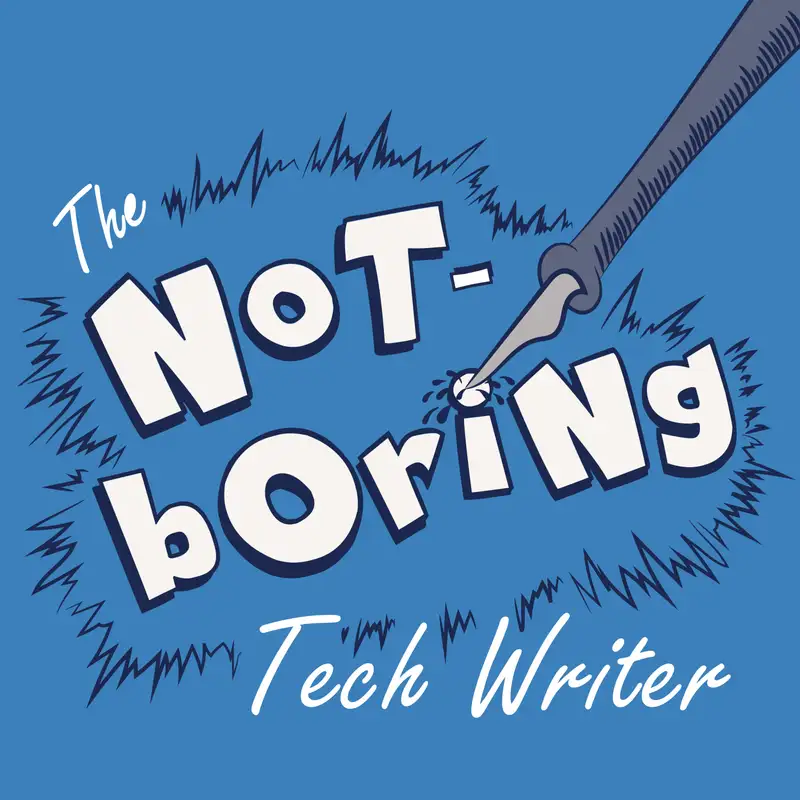
Kate Mueller: [00:23:58] Yeah. And I think we can actually use an example here. So listeners, you do not know this, but Bill is actually the one who designed the logo for this podcast, The Not-Boring Tech Writer podcast. So for those of you who have commented and said you loved the logo, this is largely Bill. I believe my directions to him were like, what did I give you? I gave you some color palette things. I gave you stuff I knew I did not want, so I knew I didn't want something that really spoke of like a computer code, for example.
Bill Holland: [00:24:31] Yeah. You didn't want a system font situation.
Kate Mueller: [00:24:34] I wanted something that emphasized the “not-boring” part rather than the “tech writer” part. I believe what we ended up with was a very early iteration. You sent back to me that I was like, “oh my God, I love that. Can we pursue that?” We ended up with this almost a little bit Doctor Seuss-ian I think aesthetic, and I really love that we went with the quill rather than something either computer based or even typewriter based.
Bill Holland: [00:25:02] Well, that was totally a crazy idea.
Kate Mueller: [00:25:04] Yeah, and I loved you for that. Which is my example of what a good designer will do is that I think what I told you, I was like, “I just want something that's fun, that is not boring. That feels joyful and exciting and interesting and it would make you want to listen to it. Where the tech is an afterthought here, not the focus.” And you did most of this, I did very little of it other than being like, here are some colors.
Bill Holland: [00:25:31] Well, and to be fair, I handed a bunch of different designs initially that were the boring designs. I was trying to think of what do other tech podcasts look like in this space? How do we fit in with them but show that we are different? And I kept trying to make things that fit and I was like, these are professional. They look good, they look clean, but like, where's the personality? And how does it say that it's not boring? And my thought, my thought was I just started sketching in my sketchbook, my little sketchbook on the couch. I'm like, I had some cartoon or something on the TV as one does. And I thought about it and I'm like, well, tech writing is done on a computer or a tablet, right? It's done in this very sort of sterile environment. And if you want to make that not boring, back in the day, you would write with a pencil or a pen or a typewriter. So I did a typewriter mockup. I think that was based on typewriter keys. I was like, that would be interesting, right?
Kate Mueller: [00:26:20] That was one of the original designs too. Yep.
Bill Holland: [00:26:23] And I think that we landed on the quill just as I drew it. And I texted you it, I think I took a photo like the sketch I drew. And I said, “what do you think of this? Like a weird whimsical quill situation?” It's the inverse of tech writing. But if you want to be not boring, that conveys that, right? It's not what you would expect, but also the colors lean into what you're doing. I think the colors are still very corporate in a way. Like they're not overly colorful or whimsical.
Kate Mueller: [00:26:52] Yeah, I still wanted it to be fairly simple and to be something that would be recognizable, in part because podcast logos are usually shown very small on most device screens, and so you want something that feels unique enough that it's visually identifiable, that there's that strong sense that I know it. And so if you look at The Not-Boring Tech Writer logo, really small, all you really see is the not-boring—like the big white lettering, the not-boring part, and you get a little bit of the quill and like a little bit of the the tech writer piece, but it's really the not boring that jumps out at you. And I love that about it.
Bill Holland: [00:27:29] That was my idea—just keep the focus on the not-boring part. Because even if you're not a tech writer, you'll be drawn to not-boring. So what's that about? And tech writers will find it. Just because you're putting out newsletters, you're reaching out to people. But I do think that jumps out, especially when you put it next to other podcasts in the category. It's like, “oh, this is a little more funky, a little more whimsical.” And I think that communicates what you're trying to do. It really is our brand.
Kate Mueller: [00:27:53] It is totally, I mean, at least the way I've interpreted it as the third host of the podcast, that is our brand. And I'm trying to think of some of the other stuff we did in that early process. I think you had me send you samples of podcast logos I really liked. Here are some of the aesthetics that I like or that Chad, our head of operations, that he liked. I think I put that call out to the team and a few people submitted stuff because we were like, “okay, this is a bit of a team effort, even though it's mostly my thing,” but I think that's a piece that's potentially useful is to be like, “hey, here's some stuff that is in the same neighborhood of esthetic that I like,” even if it's just like, “oh, look, they only use like 1 or 2 colors. And I kind of like that because it's really recognizable to me.” Right? Being able to share some of those, and I think I even gave you some description of what I liked about them at the time, and I feel like some of that was useful context for you as you were working on it just to be like, “okay, so I kind of understand, I can look at other things in this genre and see what they're doing. But I also understand that what this client is asking me to do is a little bit different from that, that they want to stand out a little bit from that landscape, but not in a gigantic or a super predictable way.” I think that's the other thing I love about it. I wanted a little whimsical along the way, and you did a great job at it.
Bill Holland: [00:29:21] Thank you.
Kate Mueller: [00:29:22] Is there anything else in that process that I am forgetting? That might be a good context for people as an example?
Bill Holland: [00:29:29] Well, yeah, I think mood boards are something I always tell people to start with is if you have Pinterest, just send me a Pinterest board that has a bunch of stuff in the ballpark of what you're looking for style wise, and then maybe like a brief that communicates what you're looking for. That's a great place to start. Every designer works differently. I personally like working on paper first, just because I feel like it gets me away from the computer. The computer programs for design can get really in your head real quick, pushing the mouse around, and I feel like it's disconnecting your brain from—the hand and brain connection is just getting disrupted by the computer. So I really do believe in writing on paper with a pen or pencil. Now, I do have a tablet now, which has actually been really nice for that, because the new tablets actually are really good at allowing me to sketch and I can quickly export the file, which is like a big thing for me. So I've enjoyed that process now of incorporating that into my workflow. But I like doing the organic stuff first because we can figure out layout and all that stuff we can figure out later. But like showing you just like, “hey, I'm thinking like a circle with a line through it. And then this is over here.” You know what I mean? And that was the thing was, we did all these very what you would expect from a tech podcast, logos. And I think that's how you should start from a place of safety. Just like, let's try to get something that just would work. And then as a designer, I always like throwing one wild card in, at least just to be like, “here's a crazy idea I had. It's a crazy idea. You probably won't use it, but take a look at it.”
Kate Mueller: [00:30:51] Unless you're me and then you're like, “hey, I want the wild card!”
Bill Holland: [00:30:55] Well, that's the thing. A lot of people go for the wild card because it's interesting and different. And yeah, we might tweak it at that point, but it's a good jump off point of like, okay, here's an idea that's a little bit outside the box that could work. And I think that's what you and I did. We talked about it, but I don't think we differed that much either. We kept pretty close to my weird late night drawings.
Kate Mueller: [00:31:13] Yeah, we were very close to the OG. Yeah. And in fact, I may dig through my email and see if I can find the typewriter key version. Maybe we'll drop that in the show notes so people can see the version that I was like, ah, right, right direction. But then you gave me the quill and I was like, nope, I'm sold. I don't need to see anything else. I knew it as soon as I saw it.
Bill Holland: [00:31:35] That's part of the process of communicating with the designer is just knowing that the first things you see might not be exactly what you want, but it's going to get there. It's part of the process of just iterating until it comes to you. And yeah, sometimes it's just random. It's like you're going in Doctor Seuss' direction for some reason.
Kate Mueller: [00:31:55] That was actually not my words. Somebody commented on it and called it that. And I was like, oh yeah, I could kind of see that aesthetic. It's not what I thought when I saw it, but it is very cartoony.
Bill Holland: [00:32:06] He’s definitely in my influences, so it's not that surprising. As an illustrator. He's in there.
Kate Mueller: [00:32:13] I've worked with designers on a few projects now, and one of the things I had to get used to doing was being able to say, no, I don't like that, but here's why. To say there are pieces of this that I like, but then there's this piece that I really don't like, and I maybe don't have the words to tell you why I don't like it, but it's kind of like it's this feeling, or it makes it feel like we're going in this maybe more formal direction than I want to go. I've had cases where I've been like, that just feels more serious than I want this thing to feel, or that's too goofy for the thing that I want. I want something that's a little bit more serious, but not in a stuck up serious way, just in a, I'm knowledgeable, you should take me seriously, you should trust what I'm saying, but I don't have to be super mega serious to do that. Which is me throwing a whole bunch of word salad. But I have found that it's sometimes helpful to tell people to be like, I don't like this, and I can't say exactly why, but here's some general reasons. Like it's around this. I can't tell you exactly why. I just don't like that part. Because sometimes I think when I first started providing feedback, I didn't want to hurt anybody's feelings. And I learned really quickly that you don't get good design that way because if you have a knee-jerk reaction about something, that's a thing a designer needs to know if it's positive or negative, like, yep, I love that thing. I hate that thing. Like, please don't ever show me anything like that again.
Bill Holland: [00:33:46] Well, you're hitting on the balance there though, Kate. You're telling them what you like first, which I think is the key to critique. Now that I have designers under me, I love when I give critique. It's, hey, I know the guy's doing his best, right? And I miss things all the time. Like it just happens when you're working fast. But I'll say, you did a great job here. This was awesome. I really love this. This is perfect on this shot. I really need you to frame this a little bit more to the left. Or the texts. Like, we just did a project where the letting was just weird. And it turned out it was just the font, specifically the struggle with the letting, by the way, is the space between lines for people who don't know. But I was just like, that looks so weird, what is going on? And then I opened the font up because I'm just not. I landed at this company not too long ago, so I was like, what is going on? And I was like, oh, the font is a little weird when it comes to letting certain letters, only certain letters. So I was like, okay, do me a favor, set the amount between these two to this amount, these two between this amount and it should look really good and send it back. And it was great. So I guess the best thing you can do is just focus on the positive first and then offer the criticism. And I think it softens the blow a little bit. If it's especially if it's something like they really put their heart into, if it's a decision they were really excited about, it feels like less of an insult or less of a letdown if it's just like, this is all really great. 1 or 2 notes here. There you go.
Kate Mueller: [00:35:06] Yeah. It's a lot like giving feedback to a junior writer who just poured their heart and soul into the thing and you're like, well, it's like 70% there. And I want to acknowledge the 70% that's there, because that's 70%. That's the right direction for sure. And these are the things that are great about that. But also this 30%, these bits feel weird to me. And for me, it has always been a bit of a struggle to find the right language. Sometimes it's like, oh, there's something weird in the spacing here. I don't know what it is. There's like too much, too little, or I feel like I'm focusing on this part and that's not the part I feel like I should be focusing on. So there's something about this that's drawing my eye there. So I guess maybe that's also a question: as somebody’s giving you feedback, because a lot of us are not visual people, what kind of feedback is useful at that point? How do we articulate more than, I like this or I don't like this. If you can provide some reasoning or some more description of why I'm guessing would be useful?
Bill Holland: [00:36:12] Definitely finding a way to articulate it is very important, whatever that looks like. You don't necessarily have to know all of the graphic design terms or motion design terms, but I do think if you can have a reference point. We started from a mood board, okay, where is this not lining up with what you were seeing in the mood board? What was it about these images that stuck out to you? What's that's not sticking out to you and what we've created? Like where is the disconnect? And I think if we can work together to figure that out, that's super helpful because you might not speak the same language about typography or about color palette or anything like that. But if you can point to where I'm losing you from what we initially talked about, I think that's extremely helpful. So just come prepared to do more than just like, don't say, make this pop more. That makes us, most designers want to punch a hole in the wall when they hear make this pop more. Okay, so that's just a piece of advice.
Kate Mueller: [00:37:08] Step one, don't say make this pop more. Got it!
Bill Holland: [00:37:10] That will drive us insane. Yeah. The vague corporate speak we hear a lot is, yeah, make this pop more. Or I should have written down a bunch of my favorites. I'm blanking right now, but basically, don't say something that is not helpful. Come up with a descriptive way of like, I think the text is maybe taking up too much room here, or maybe like, I don't know about this color palette, it's too cool. Maybe we try some warm tones. We can experiment. There's always the idea of like, you could try it one way and then another. So maybe let's see the two side by side and see if that's better. Do we try different font pairing? Maybe the font pairing is off. Maybe one is great and the other one isn't. There's all that kind of stuff. That's even a thing where, like with font pairs, you could do three different versions, each with a different pair of fonts, just to see if that changes it up. There's stuff like that that you can adjust for what we did with the logo. I mean, that was a weird case because you were just happy with the weird selection I came up with.
Kate Mueller: [00:38:06] Yeah, we lucked out on that one a little bit.
Bill Holland: [00:38:08] But had we been looking at just the typewriter logo, for example, I think what you could have said was this looks maybe a little too technical, maybe a little too plain, and we want to communicate something more accessible, a little more exciting. How do we do that?
Kate Mueller: [00:38:23] If I think about it, if that had been really mostly what you had given me, for example, I think what I would have said was, I really love that you went against the grain of having it be like a computer or code. I love the callback to the typewriter, but there's something about it that's a little, I don't want to say sparse, but I get no emotional response from it at all. And because we're The Not-Boring Tech Writer, I wanted a little pizzazz, and I think that would have been the place that I was like, I want a little more pizazz, whether that's color, whether that's we take a different approach. So I think that would have been my feedback if that had been all you gave me. I did love it in the sense that it felt like it went counter to the rest of the genre, which I did really appreciate. But you gave me the wild, wacky one, and I was hooked on that one.
Bill Holland: [00:39:16] The other struggle to was we were trying to create both an image for the podcast and a logo at the same time, which a lot of podcasts, they have an image that has the logo in it, and we were trying to kill two birds with one stone because if we were doing just an image, there were things we could have talked about. Like do we do some 3D and do the buttons flying off the typewriter? I don't know, there's stuff that we could have come up with that would have been interesting, but not necessarily a logo. So that's the hard part too. It's like we're doing a logo and a thumbnail at the same time. It was fine. I mean, a lot of people do that. I did that for my podcast.
Kate Mueller: [00:39:51] Actually, I think this might be a perfect time for us to take a break. So let's take a break and we will come back. And I will ask you more random questions.
Kate Mueller: [00:40:00] This episode is sponsored by KnowledgeOwl, your team's next knowledge base solution. You don't have to be a technical wizard to use KnowledgeOwl. Our intuitive, robust features empower teammates of all feathers to spend more time on content and less time on administration. Learn more and sign up for a free 30-day trial at knowledgeowl.com.
Kate Mueller: [00:40:22] All right, we are back. So Bill, I mostly at this point have steered us into what I would call flat visual assets. And obviously a huge part of the benefit of having you on is that you do motion graphics. So I would really like to dig into that a little bit more, because it is an area that I'm hoping to maybe expand in my own documentation and something that a lot of us have even less experience with than working with designers in general. So is there anything different between what we've already talked about and what it's like if you were doing an actual like graphic or motion project with somebody rather than a static image?
Bill Holland: [00:41:07] I mean, absolutely. Weighing expectations in those situations is really important because there's so many types of motion, so many types of animation, and you might not have the skill set to attack something either by yourself without a team. And if they're expecting you to, say, meet a certain budget expectation, you have to know what you're getting into. And a lot of times, people don't like the quote I give out when they've sent me something and I'm like, “well, you want CGI animation,” or “you want fluid traditional animation in a digital format.” It just takes longer and one person might not be able to do it. I might have to outsource a few contractors and act as the main animator and then have them work with me. So there's a lot of that. And there's a lot of setting budgets before they know what they want or what they're doing, which is a huge problem because you don't know how much this will cost. And on top of that, you're setting expectations on the type of animation being done. And I think a lot of people do need to educate themselves a little bit on the scale of pay. Like what it costs to create a certain piece of animation. Obviously, in the world of being able to hire a freelancer like me, you're automatically saving money because you are going to the source. You're not dealing with the middleman of an agency that has a ton of overhead. Now, I mean, there are benefits to that, and there are cons to it as well. I mean, working with an established agency that has like one person assigned to just the business part of your account and the contracts, there's an advantage to having that because you have a whole team of people who are working there. But you also are going to pay a lot more.
Kate Mueller: [00:42:42] So you have to pay for that whole team of people who are helping to provide the service, right?
Bill Holland: [00:42:46] Yeah, in my house, so I'm just billing you literally the hourly for the time I'm spending on this or if I have to hire a contractor for whatever they're spending. But we're not dealing with the same overhead. We're not dealing with a lot of the other costs that go into that. It depends. You need to know what kind of animation you want. Because if you just want simple moving text and you just are like, just make the text move. Cool. Easy peasy. Right? And then there's “I have a logo that I want you to animate,” which in your case was the KnowledgeOwl logo.
Kate Mueller: [00:43:16] Yes, I made you make Linus fly. And he's not really designed for flight. So that was an exciting endeavor.
Bill Holland: [00:43:23] Yeah, we had to build him out a little bit. I had to rip him apart and put him back together again. The challenge there is obviously how do you make him look like he's flying, but have him land in the position he is in in the logo, which is a challenge because you have to figure out how to like, you have to build an extra wing for the back so he can flap, but then it has to look natural. It's hard to make him look natural no matter what.
Bill Holland: [00:43:46] You want some kind of natural movement in there. And that was what we'd call puppet animation. And it's exactly what it sounds like. It's you build out a puppet that then is puppeteered essentially in the digital software to land on the logo, and that's going to be more involved than, say, just basic text animation or making shapes animate, things like that. It is going to be easier than, say, traditional animation, which is where you draw every frame by hand. That's incredibly expensive animation, and it gets more expensive depending on how many frames you draw, because you can do a more basic version of it where there's a new frame, every new frame of animation, every like six frames. But then like if you look at traditional Disney animation, for example, something like Sleeping Beauty or Snow White had a new drawing on every frame of film, and there's 24 frames of film per second.
Kate Mueller: [00:44:35] That's a mountain of drawings. Wow.
Bill Holland: [00:44:38] Yeah, detailed, complicated drawings. And now obviously, there's a lot of factors here. Like you can do what's called animating on the ones, which is what they did on Snow White, where there is a frame, every cell of animation. But it's going to be different, say, drawing Snow White and animating her than if you had like a bouncing ball coming in and landing and turning into an O. That's going to be an easier piece of animation, even though there are all those frames. And on the other hand, there's a technique where you can animate on the fours or the sixes or twos even, and you're splitting. Essentially, you're cutting in half the amount of drawings you have to do. So that's a huge time saver each time you cut out the frames. Bill Plympton is an animator if anyone's familiar with it. He did a lot of commercials back in the 80s and had some short films, but he's somebody who would animate as far as like the sixes. So these detailed colored pencil drawings. But he was able to do them and work them into his ads and films because they were further apart, like you weren't making one every single frame. It was spaced out. All this to say, there's so much that can determine how much animation costs, what goes into it, and it can vary. So coming in with a set budget and saying, this is what I want is not great, because you’ll probably either get somebody saying, we need to leverage. We need to kind of work on your expectations here.
Bill Holland: [00:45:58] You need to have a bigger budget. Or you'll have somebody who takes it on and doesn't know that they've taken on more than they should. Like if you find a younger animator who will do it, odds are they're going to be biting off more than they can chew, and you might have delays in delivery. It might not be what you're expecting, and expectations just might not be up to what you want or what you desire. So I think that comes in with a range of a budget of what you want in your head and pitch. Like I said, you can do the same thing with mood boards with Pinterest because Pinterest I believe handles video now. Or make a YouTube playlist of just like, hey, here's some short ads we really like the look of. The other thing is not just looks. So like I would say, I almost do two different boards, do a Pinterest mood board for design style, like here are styles we really like and looks we like. And then I would use one that is like a YouTube playlist or something that highlights ads or videos or short films that contain animation similar to that style of drawing, but that contain the type of movement you want. Like what type of movement do we want? And then what can happen is I can say, okay, this is the type of animation you're looking to do. This is what it would require. Would I have to hire extra people? I need to look into that. How long would this take to accomplish? What are the tools involved?
Bill Holland: [00:47:18] And then I can throw a quote back at you and if you're like, whoa, that's way outside what we want to spend at that point, we can look at it and say, okay, well, this is the budget I would need to accomplish exactly what you're describing. But the look is easy, the look is usually the easiest thing to accomplish. So okay, if we take this, how can we simplify it? Do we limit movement for example, maybe not everything the image moves. Maybe one character has an arm that moves up and down and maybe a leg. I do that a lot, where we'll take a really complicated illustration, but we'll chop out the arms and the legs and the hands and make nice fluid movement in certain parts of the image. And then maybe some like basic background movement. That's super easy. Just set one keyframe, set the end keyframe and it just moves across the screen slowly. There are ways to get around it. Do what's called limited animation where you move certain things, but not everything has to be redrawn or has to keep moving in every single frame. So don't lose hope when you get that budget figure thrown back at you. A lot of times it's like there needs to be leveraging of expectations. If you don't know how much animation should cost for what you're expecting, be prepared for sticker shock. But also be prepared for the conversation of like, okay, well, what can we do given the budget that we know we have to spend?
Kate Mueller: [00:48:33] What does that process actually look like? I'm assuming it's much more involved than the sort of static visual assets because there's so many more variables at play there.
Bill Holland: [00:48:47] Yeah. The way the process would work is once you've decided on the style and the type of animation you're going to be doing, I would normally mock up what are called style frames, which are just like reference frames for the main scenes in the piece. Sometimes I do those before I even do what's called a storyboard, just to make sure that I'm in alignment with the client and I'm not wasting their time and money. And then we might flesh out the storyboard using those frames, design every single scene, frame by frame, so we know exactly what we're animating and get it signed off. Once I get signed off on that, then begins the actual animation process, which is going to be—ysually it depends on what the expectations are. Some people don't want to see the rough animation and it might not matter to them as much, but I do like to show roughs early on if I can, just to say here it is with limited movement. Here's how these will move. I'm going to flesh out the animation and refine the hand movements or heads or whatever. But here's the character bouncing from point A to point B, here's how it's going to move. But then you run into the problem. Some people are so literal that they just might not understand that. And it might just be harder for me to show them a rough animatic like that. So it really depends on the client and how they like to work. Some people just want you to deliver a final product, but that's not ideal just because if there is something wrong early on, you want to catch problems early on because animation takes so long.
Kate Mueller: [00:50:14] Yeah, that's what I was immediately thinking. The advantage to showing somebody a rough idea is that if there's something that's off, you've caught it early enough that you can fix it then instead of doing all that work to get to the finished product and then discovering that something early on in the sequence is off and having to redo all of that stuff.
Bill Holland: [00:50:38] And honestly, the storyboard, once that is established, once that is locked down, what I mean internally, if anyone up above your department needs to see that storyboard or sign off on this video, they need to see that storyboard and sign off on it, because you don't want a situation where you've spent all this money on animation with animators, and then you find out they don't like the direction this is going at all. And then, I'm still going to bill you for our time that we agreed on. So that's my time wasted as well. So I think that the ideal is to use the pre-production process to kind of work all the bugs out. And that's just my philosophy across the board. Like with this client I'm working with now as a freelancer, I've really been pushing for them to do work with me on more pre-production, and they've been super receptive to that because they know that if we take the extra time—and there are a few, there's always going to be somebody who maybe doesn't quite understand the process until they see it. But I think 9.99 times out of ten, if someone sees your pre-production process and sees how it benefits the end product, I think people will always get it once they see that you've got the storyboards. I can see frame by frame, how things are moving, and then I sign off on it.
Bill Holland: [00:51:52] As a technical writer or someone communicating with the motion designer or animator, I think the biggest thing you can do is do so much detailed communication up front, because once the project is moving, it's a lot harder to change course. So you want to make sure you get all of your details, everything you need communicated that all needs to be handled upfront in what's called pre-production. Before we ever start putting pen to paper. It's not really usually putting pen to paper, but you know what I mean. It's like you don't want people working on this, right? It would be like running an assembly line on a car into production. Like putting a car into production at Ford before the design is done and just being like, I don't know, line workers figure it out. You know what I mean? Like you're just slapping that piece on there from this car. It's just you want to make sure everything is designed properly before you ever go into production. And I think that's a great way to explain it is just like you're designing a product that's going to get put into production on an assembly line, essentially. And if it's going out, not finalized or someone hasn't signed off on it, you're going to waste so many man hours and so much money and time. So just get it all right on paper first.
Kate Mueller: [00:53:09] Yeah, I like that metaphor.
Bill Holland: [00:53:11] It's a very Detroit metaphor.
Kate Mueller: [00:53:12] It is a very Detroit metaphor. For those of you who don't know us, we are originally from the Detroit area, and I lived in the Upper Peninsula of Michigan. So we have some big three references between us, I think.
Bill Holland: [00:53:24] For everything really.
Kate Mueller: [00:53:25] Yes, yes, a lot of formative Midwestern references, auto industry references. We got a lot of it. Great lakes stuff.
Bill Holland: [00:53:34] Eminem. Bob Seger.
Kate Mueller: [00:53:36] Yes.
Bill Holland: [00:53:37] Motown.
Kate Mueller: [00:53:38] I'm trying to remember. I think when you did the animated version of Linus, you did send me something in the middle that was like I told you roughly what I wanted, and then you sent me something. But I don't remember what it was, that kind of gave me a sense of the sequence. I want to say it was like maybe 4 or 5 bits of the sequence, kind of the key points where the movement would be different.
Bill Holland: [00:54:04] And that was the rough animatic. That was where the key animation had been done, where there were five positions that he would here's how he's going to arch up. Here's how he's going to swoop down. And here's how he's going to land. And then here's like the final lockdown and into it.
Kate Mueller: [00:54:18] Yep.
Bill Holland: [00:54:19] And that way you could see how he was going to move, how the timing would work without me having to tweak his feathers or his movement or smooth it out. Because once you start doing that, it can be a lot to have to go back and fix it. So I wanted to just get that signed off on before I started really getting in the weeds with it.
Kate Mueller: [00:54:35] And where in the process did we talk about the background music for it? Like, when did I need to have that picked out for you?
Bill Holland: [00:54:46] Background music, really, I think we had to do that early on because we we wanted music that had a good end sting on it. So I think you were looking for that while I was working on the animatic, if I remember correctly.
Kate Mueller: [00:54:56] I think that's right, because it also felt like we had to nail the personality bit of it, and that we wanted it to kind of fit with what the animation was doing. Yeah, I think you're right.
Bill Holland: [00:55:04] Well, that's the thing. Character animation is a thing too. Character animation revolves around character and emotion and performance. And even though Linus is solid, he's just a logo. I want to give him a little bit of just just some feeling to him, like, who is this little quirky bird? And so that's why I wanted him to be a little frantic, to have a little bit of land. And it's this type of thing. Feathers flying.
Kate Mueller: [00:55:26] Yes.
Bill Holland: [00:55:27] I love that very much.
Kate Mueller: [00:55:28] It's his personality anyway. And we get like a couple of the little feathers, like falling off as he lands and a couple other things, like there's just some nice detail in there that got worked in. But yeah, and I remember I must have listened to—you sent me to one of the sites to try to find the music for it, and I must have listened to like 200 or 300 at least little blips to be like, is that Linus? No. Is that Linus? Maybe. And then I narrowed it down and I shared some of them with the team. And then finally I was like, okay, I think this one's my pick. I hope everybody else likes it. And I shared it and they were like, I like that. I was like, Thank God. Okay, that's what I'm sending to Bill. I'm done looking. This sounds good enough. I'm just going to send it to Bill. I also really wanted a bit of his personality to come through. And so I was looking for that in the animation and looking for something that was like, hey, he is a little playful, a little out there, definitely hard to animate flying. His body shape is not a traditional owl in that way.
Bill Holland: [00:56:32] Right.
Kate Mueller: [00:56:32] But you did a great job with him, considering that he's really like a basketball with a triangle and then like a little head. Do you often have to redo stuff after that rough phase or is it massive tweaks at that point? Is it a small tweak? Is it all over the place depending on the client and the project?
Bill Holland: [00:56:55] It really depends on the detail. I mean, I feel like if if it's somebody who is really concerned with the character and if the character feels like it's not real, like if I had animated Linus that way and you're like, no, he's actually a distinguished gentleman who's very demure and doesn't chaotically land like that. You might say like, no, I want it to be more smooth and straightforward. And I've done that before for like I did a project for an architectural visualization firm where they wanted the bird in the logo to kind of fly in and land very smoothly. So it was more of like a graceful fly in that we had to plan out. But I do think there is a little bit on my part education with clients who don't understand how the process works with the animatic, they might get the animatic and say, why is it moving that way? And I have to talk them through it like, well, this is the first stage. I'm showing you where things are going to be laid out, where the character goes from point A to point B, but I'm refining as I go. I'm adding more bits and more layers. With hand-drawn animation i's easier to show in a way, because you have to start with what's called a pencil test. So it's going to start as a ball, and then I'm adding arms and legs as I go, and then eventually it's going to and then I might not show you that whole process because you might not understand all of it.
Bill Holland: [00:58:00] But once I have a character animated, you'll see that. But then I'll go in and add the hat and the scarf and all this, and the layers will be added and eventually you'll see it come together. But there is always this question of like, how much do you show the client because of how knowledgeable or willing to embrace our sort of workflow are they? And sometimes you might have a client who's so literal that you just have to figure out, like, okay, well, where should I actually show them my process, and where will it be detrimental to what I'm doing if I get in there too soon? So everybody's different. You just gotta feel it out. And I don't think there's really a true science to it. It's just kind of like feeling out people's personalities, how they work and then just gently educating them if they don't know how this works, if they've never done work with an animator or motion graphics designer, just gently help them understand the process. So in a way, you're acting like a tech writer. You're having to give them a detailed outline of like, here's how this works, here's why we're doing it.
Kate Mueller: [00:58:58] Here's what to expect when. And I guess maybe this is a question I should have started with, but we're getting to it here at the end. For folks who haven't worked with anybody like this before, and they are looking at freelancers or agencies or whatever, what do you look for or what are the questions that you should ask? I mean, I knew you and I went and looked at your website and looked at some of the work that you had previously done. And I was like, oh Bill's way more talented than we need, but what should that process look like if I'm out there trying to find a designer or an animator to work with, what are the things I should be looking for, or what red flags would be a sure sign that I shouldn't work with them?
Bill Holland: [00:59:43] Sure. I mean, I think a portfolio website is good. I think everybody should have a website. I think, go through the portfolio, look at what they've done in, like if you're looking for illustration, look at the illustration work they've done, look at the motion graphics work they've done. One of the things to look out for is I always put in my main motion reel, if you actually click on the video and go to my Vimeo, it has a list of what I did on every single project. In this shot, I was the modeler, or I was doing the tracking and motion graphics in every shot I did.
Bill Holland: [01:00:58] Not everybody does that, but they really should, I think. And if somebody didn't, you could always write them back and just say, hey, I'm just curious. I noticed on your reel it doesn't really say what part you played in all of these pieces. So I don't really know what role you were in and what you did on this. And I think it's super helpful to know that because it tells you what their skill level is and what they're capable of. Sometimes people show off a reel—this is more of a younger designer problem, but they get excited to put anything they've worked on on their reel. But it's like, oh well, this is from the piece I edited and it's like, well, that doesn't belong here. Or it's like they did something that they were part of a team of ten people. So it's like, I need to know what they did on that shot. You can't just put it in there and say you did it because it was a 3D shot that required compositing and texture painting and mapping and all that stuff. So I think the biggest thing is—and I mean, you can tell too, just in terms of presentation, I think sometimes it's pretty obvious how much has this person actually worked on? Not that you shouldn't hire somebody who's young and inexperienced. It's just that that's going to set your expectations about what the process might be like.
Kate Mueller: [01:01:21] Yeah, they may not be as good at managing you as a client, for example, or managing the process itself. But I'd imagine you probably get less of that hand-holding, “let me explain to you what this process looks like or what these types of animation are” or whatever, from somebody who themselves isn't as used to running projects and hasn't had to work with as many different clients and doesn't know how important it is to set those expectations.
Bill Holland: [01:01:49] I think that's something as a designer, as you get older, it can be kind of intimidating to see kids who came up, who are coming out of college, younger people, and they've had access to computers that can run these tools their whole lives, basically since they've been conscious enough to work with them. Whereas I had to, I came up at a time where you couldn't do any of this on computers, basically, or like you were just starting to when I was in high school and into college, and they were really slow and definitely not 3D. For 3D, you needed a specialized computer that they have one of at the college. So it's one of those things where it becomes frustrating because you see people coming out of college with these incredible, beautiful reels. But what we start to realize is like, okay, they're coming out of college with a beautiful reel, and they're going to be able to eventually get really, really good in a way you couldn't that quickly. But also you have years of experience managing projects, dealing with clients, communicating, so you can manage them and help them get better at their craft and be like an apprenticeship type of situation at work.
Bill Holland: [01:02:50] But they still need you as a designer to, although, you know, that may be intimidating somewhat. It's like, don't get intimidated because you have the skills of dealing with clients, of delivering on time, of keeping schedules organized and stuff like that. So I think that's something that people you start to get a little insecure about as you get older because you realize like, oh man, they have cinema 4D on their computer and like middle school and like they're modeling in high school and doing and making crazy video games and stuff. And it's just like, wow, it's wild to see. And then of course, I've been able to use that stuff, I've had no free time in my life, basically because you're working the whole time. But yeah. And my point is that of all that is that hiring an experienced person does have the value of that.
Kate Mueller: [01:02:58] You get the experience to come with it, and if you're going less experienced, you might be getting what ends up being a pretty good product. But the process to get there might not be the same, and so you might not get the same maybe nuance or level of detail in the finished product, because maybe they're not as experienced dragging some of that stuff out of you to figure out that you actually do want something slightly different here. Right?
Bill Holland: [01:03:30] Right. And I'm not saying don't do it, I'm just saying that is something to keep an eye for.
Kate Mueller: [01:03:33] To enter into it with the understanding that that's what you're getting.
Bill Holland: [01:03:39] Right. Manage expectations based on what you're looking at.
Kate Mueller: [01:03:43] Yeah. I guess maybe the one other question I can hear somebody asking this in my place, so I'm going to ask about it: with the advent of AI, I can imagine somebody being like, oh, well, I could probably just use AI to get what I want out of this somehow. And as somebody who's been really involved in the AI side of animation as well as animation, pre AI, like what is the learning curve like to actually get good quality stuff if you are trying to use AI for that? Is it reasonable for somebody to think, hey, I could probably figure this out on my own.
Bill Holland: [01:04:20] I mean, there's somebody at your company, for example.
Kate Mueller: [01:04:23] Yeah, exactly. Like if we had, like a 22 year old who was super, super excited about it and was like, I could probably learn how to do this. What is that like? Is that even reasonable?
Bill Holland: [01:04:35] I mean, sure, theoretically, if that's what their specialty is, I don’t think it’s as easy as people make it out to be to get good results. I mean, first of all, I mean, full disclosure, I've been creating AI content in the last year that has gone under the radar that people don't realize is AI now. What we're doing is essentially using established IP that we own rights to. We own these photos and we're animating them. So we're not creating things out of whole cloth. Right? We're using AI as a tool. It's a means to an end for what we're trying to do. But we see a lot of pushback to what's called AI slop, which essentially you're having the AI create an image and then animate it. And the thing is, like there was a recent ad by Coca-Cola that got a ton of backlash for looking like AI slop that was designed in AI. And we're talking about they had teams of which I don't remember the number. It was a lot of people on this team generating all these prompts and trying to get everything just to get that ad to look like that. And in my mind I'm like, is it worth it if people hate it? Like, at that point, why didn't you just hire a 3D studio and like some animators. That's the thing where it's like, is it worth it to do it in AI fully if you're just going to have to hire a massive team of people anyway, and then people are going to hate it because it's not actually made by these artists, it's made by AI?
Kate Mueller: [01:05:58] Because it still looks like AI.
Bill Holland: [01:06:00] And it looks like that's the biggest problem. It looks like AI. You're not fooling anybody. I think there are ways to compare, like Peter Jackson's Lord of the Rings to his Hobbit. I use these examples because a lot of people know those movies. The Lord of the Rings, the big thing was when that came out, how much he was not relying on CGI, and a lot of it was done with models and miniatures and what were called bigatures, which were like oversize miniatures that could be used in place of sets, and they would composite that with CG shots of they had photoshopped like mountains, right, for the matte painting and put all that together. So they were using CGI for things like the big elephants and things like that, some of the orcs. But for the most part it was people in masks and makeup, right? It's a hybrid process. Fast forward like a decade later or so, and he does The Hobbit movies, which are mostly shot on a green screen stage. Tons of CGI, way less models. I mean, they still did use models and things and bigatures for that project, but they were far more reliant on green screen. And it looks worse than Lord of the Rings somehow. And I think with AI, it's going to be the same thing where it's like, you can't just rely on AI, you need reference images, you need to shoot plates and combine things. Something I've been experimenting with is using AI to generate human, what I would call sprites like characters, and then dropping them into 3D or actual shots that I've designed using actual compositing software. So like, it's not all AI, it's I'm using AI to take care of things that would take me hours to do. I'm speeding up my workflow, essentially.
Kate Mueller: [01:07:34] But much of the actual animation piece is happening secondarily to that it sounds like. You're using AI for the initial generation of some of that stuff, but it's not the entire animation. There's other layers to it that you're doing. Using other tools.
Bill Holland: [01:07:51] A sampling is a good example of this in music. I once talked to this band called, I don't know if they're pronounced Coop or Co-op, but they're kind of like a lounge act. But they told me I asked them about sampling and they were like, well, we're not gonna tell you what records we sampled. And I said, okay, but I'm just curious, like, how do you go about sampling? Like, how do you make what is sampling and what's not on this record? And they said, well, what we do is we sample the cliches, the things that are in all of these records, like just micro samples of all those things, combine them and then play live instruments with them. So it creates this whole contextual piece of music that makes sense together. And I think that the same thing is true of where AI is going. It's like, you can't just have the thing in a vacuum. You have to use it with other technologies. So I think, yeah, for basic stuff, if you want to animate a photo, for example, that's a great use of it for like a social media manager, for example, if they want to just animate a photo, you can get a prompt online that can easily animate a photo in a space.
Bill Holland: [01:08:49] If you want to show off a piece of real estate, for example, in a social media ad, I think that's a great way to use it that won't really raise a lot of red flags with people, but when you start wholesale generating stuff from scratch and AI with text to image and then animate it, people can just tell and they don't want that. So I think you're still going to need to hire somebody who knows how to design something properly, because there's just there's a taste element, there's a craft element, there's choices that we make that even with AI, if you're using AI, having somebody who knows how to program the AI to get better results so it doesn't look like AI slop, that's a skill too. That actually requires a lot of skill because, I mean, I'm designing huge node based workflows right now that communicate how I want angles to change and camera shots to move within a photo. So it's not like it's a simple turnkey process every time. Sometimes it can be, but usually not, Especially if you want to again avoid AI slop, you want it to look good. I can talk all day about this.
Kate Mueller: [01:09:49] Yeah I know. I mean, I feel similarly about the use of AI on the documentation side. So I think we're strongly aligned in that there's a place for it, but it's not a wholesale replacement. It is more like it's a component that you would incorporate, rather than the entirety of the tool that you would use.
Bill Holland: [01:10:10] Well, more so in your department, like something I have been using it for as well is ChatGPT. You can create scripts right with ChatGPT, but it falls into telltale signs of AI writing quite often. And then also horrible cliches. Just awful. And so I can use it for ideation, but I'm always finding myself rewriting what i's written, either for clarity or for the sake of language. And sometimes it just sounds stupid. So you can also keep prompting it to do that. But sometimes I'm just like, this is a three sentence paragraph. I'm just going to rewrite the stuff that doesn't work and just use that and move on. I don't want to keep playing with this thing to get it to come out right. You know?
Kate Mueller: [01:10:50] Is it saving me time if I'm spending 45 minutes trying to get it to write the three sentences the way I want them written.
Bill Holland: [01:10:57] I do think a great use for it is organizing data from PDFs or something I've been doing. So we haven't talked about my podcast at all, but I have a film podcast that I do on the side.
Kate Mueller: [01:11:08] Oh yes, I was hoping we'd get to this at some point. So this is great. Go for it.
Bill Holland: [01:11:14] So I run a podcast with my friends. I grew up Catholic and I've kind of left since, but I've really always been fascinated by films that were condemned by what was called the Legion of Decency. Today it's the US Conference of Catholic Bishops, and I'm someone who had both good and bad experiences in the church. So I wanted to do a podcast delving into some of that, but mainly focusing on the movies as a way to talk about these things and sort through them. It's called Morally Offensive. So it is for adults, but we have a good time. And I do try to be fair with what we say about people and events and things like that.
Kate Mueller: [01:11:46] But I would say you do a good job. I'll also just put in a little plug and say that as somebody who's not like an absurd film buff and who also is not Catholic, I've really enjoyed the show. It's gotten me to understand a lot of stuff about the film industry, particularly the pre-Code era, that I didn't know anything about. It also surfaced a whole lot of things about Catholicism that I didn't know anything about, but all of that in a really accessible way. And you tend to have really good rotating co-hosts and guests and I've discovered a huge love of Mae West now as a result of the podcast.
Bill Holland: [01:12:22] I love that, I love Mae West.
Kate Mueller: [01:12:24] And honestly, one of my favorite episodes was the Nosferatu episode.
Bill Holland: [01:12:29] Oh, really? Yeah. That's excellent.
Kate Mueller: [01:12:30] It may have also been that I was listening to it in the dark while driving in the rain, in the fog, which just felt like ambiance wise appropriate, but it's a fantastic podcast. We will link to it in the show notes if you guys want to go check it out. It's a lot of fun. For example, last summer you did the theme of Hot Priest Summer.
Bill Holland: [01:12:54] Just a little naughty. Not too offensive. Just naughty enough to where your grandmother probably doesn't want to listen to us, but I think somebody our age or younger.
Kate Mueller: [01:13:03] No. Probably not. Especially not if she's Catholic!
Bill Holland: [01:13:06] Oh, right. Well, yeah, but we actually have a lot of Catholic listeners, so it's kind of been weird to realize that and think and realize that, like, okay, there is this commonality and we have shared experiences and as long as we aren't mean, I don't like being mean at all. So my criticism is always kind of like, I just want to help and maybe help people improve a little bit or just fix things that are pushing people away. But anyway, that being said, something I do use AI for on that podcast is organizing data or material. So a lot of times I have to work very quickly. We aren't really making much money with the podcast at all, so it's something I do in my free time. But what we've found ChatGPT really good for is, I mean, don't ask it to tell you facts about things. I occasionally do use it to find something. If I need to find something, I'll be like, hey, we're in the Catholic Catechism does it say this? And please provide the source link. And then I'll use the source link to go actually look at the thing. And I'll use finder, the find function in the browser to actually go find what I'm looking for. But it's really great for if I have a 600 page book in a PDF format that I need to get information out quickly, I'll upload it into ChatGPT and say, hey, can you let me know in this document, pull me every section where it mentions, I don't know, like we were talking about anti-Semitism in Nosferatu. Not to get too heavy on your podcast, but we're talking about the history of anti-Semitism.
Kate Mueller: [01:14:24] It is definitely not boring, so go for it.
Bill Holland: [01:14:26] Yeah, this is definitely not boring. But we were looking into anti-Semitism as it's been tied to claims of Eucharistic miracles. Eucharist is like the Catholic version of communion, where they believe it is the literal body and blood of Christ. And something we found historically is there are a lot of instances where there were claims of desecration of the host, which is the bread, and basically what would happen is there would be a claim that it bled, or that it turned into like real human skin. And then that, combined with the desecration, was taken as a sign that a group of Jewish people should be oppressed or exterminated in a certain city or something. And I want to be clear, this is like a local thing, right? It's the local priest or local bishop or it's the Catholics in the neighborhood. This is not a worldwide thing.
Kate Mueller: [01:15:20] Official sanctioned global. Yes.
Bill Holland: [01:15:22] But we were trying to understand it because I grew up reading about a lot of these same miracles, and no one ever told me about this. So when I started finding this out, I was like, I would like to know more. So I started downloading documents from primary sources, the Vatican and also churches in Brussels where this one event happened. And I told ChatGPT, hey, take this PDF. I want to know where these sections are so I can go find them. And it just makes it so easy to sort through documentation without using it blindly. Like a lot of times Google AI, for example, gives you terrible information. Like you should never trust Google AI honestly. And you have to learn how to use it as a tool. It's not meant to replace the process of finding info.
Kate Mueller: [01:16:03] I like the use of giving it a big document and being like, find the instances of this and tell me where they are. It's like a control-f but on steroids kind of.
Bill Holland: [01:16:15] Exactly.
Kate Mueller: [01:16:16] Yeah. And then you go read the actual original source material.
Bill Holland: [01:16:22] Well, that's the thing I'm always copying and pasting from exactly the primary docs. I don't want to hear what it sums it up to say. I want to look at what it actually says, because sometimes its interpretation might be off. For example, it might say, well, this says this. And I go look at it and I go, ah, but in context, maybe not. So I don't want to jump to conclusions.
Kate Mueller: [01:16:39] Yeah. I mean, within the sentence could be interpreted that way, but within the page it's actually saying something slightly differently. So maybe to kind of wind down a little bit, since we've talked quite a bit about working with designers about different types of animation, are there any resources you can think of that might be helpful for us to share with our audience around any of the things we've discussed?
Bill Holland: [01:17:05] Since we are on a podcast, there are several podcasts, I definitely can recommend one podcast and that is the podcast from School of Motion, which is an online school that I took courses at to get better at character animation. And they interview a lot of people from agencies, independent freelance animators, illustrators, people in the industry doing this type of work. And I mean, there are people who are like worlds above where I'm at with stuff and they're handling insane projects and doing incredible work. And what I like that they get into a lot is they do talk a lot about this. There are a lot of episodes that talk about how you communicate with clients, how you work with clients, how you maintain clients. And so that would be a good place to get just our perspective on what we do and how to work with us. I think School of Motion has been great. They have a great team and pool of people who have gone through there. One of the guys who used to be with them, actually lives down the street from me now, and he was not always here in Milwaukee. I just got lucky that he is a neighbor.
Kate Mueller: [01:18:04] Of all places to end up, Milwaukee.
Bill Holland: [01:18:06] And like, not just like a few blocks away. So we'll go grab coffee occasionally and just catch up on what's going on. He's a creative director, so he's super busy too. So we have to force ourselves to get out of our little cubby holes. That's the other thing with motion designers. Now we're all remote. So we all have meetup groups because we're like, we need to actually like, hang out once in a while because we used to all be in offices together. Right? And now it's like you're working isolated from everybody or with or somebody who's on the other side of the world. So it's a different environment and you have to work to stay connected. But yeah. School of motion. Their podcast is great.
Kate Mueller: [01:18:38] Is it just called School of Motion?
Bill Holland: [01:18:41] Yeah. schoolofmotion.com. It's just the School of Motion podcast on Apple Podcasts or Spotify.
Kate Mueller: [01:18:48] Bill, what is a great piece of advice you've been given? It does not have to have anything to do with any of the conversations we just had.
Bill Holland: [01:18:56] I've always lived by this quote from the Catholic author G.K. Chesterton. The quote is, “I owe my success to having listened respectfully to the very best advice, and then going away and doing the exact opposite,” which is a paradoxical quote.
Kate Mueller: [01:19:11] Very meta to share that piece of advice, I love it.
Bill Holland: [01:19:15] I know. Thank you. And I'm not saying that's always true, but I have gotten good advice over the years. I've gotten well-intentioned advice that my gut told me was incorrect, and I ended up making the right decision in the long term, just because those people were only seeing the immediate, and I was trying to look forward to what the next move would be. What's the next thing that's going to happen? And I think a lot of times you will find yourself in those situations where people will give you really good advice for 2026, but what is the best advice for 2030? And you always have to be adjusting your expectations and looking toward what might be the next development in the industry. When I got out of school, I was doing what I didn't think I'd be doing when we were at Northern. Now I'm doing stuff that I didn't think I would have been doing a decade ago. So it's like you just gotta keep moving and keep adjusting. And the respectfully part's important too, because don't disrespect people who give you good advice on what to do with life. It's like they mean well, a lot of times they are right. But if your gut tells you something's not quite right for you or the correct thing to be doing, or the correct way to do something, at least ask the question if maybe don't be negative about it. But is there a better way to do this, or is there a better direction to be going in? And I've always benefited from that paradox of a quote. It's just a good piece of advice that doesn't quite make sense when you think about it, but then when you break it down, it kind of does.
Kate Mueller: [01:20:40] And also somebody can give you something that is a good piece of advice generally, but might not be a good piece of advice for you. And I think it's on each of us to evaluate that. It's that, does my gut says that this feels like a bad piece of advice? Because it could be great for somebody else, but maybe awful for me.
Bill Holland: [01:21:03] Well that's true as well. Context.
Kate Mueller: [01:21:05] We often do give advice from our own experience. And so sometimes you're getting advice from somebody whose experience is just wildly different. And sometimes that leads to very good advice, but sometimes it means that their advice is almost constrained by their experiences or their perspective. And if you feel that there's a disconnect there. It's worth it to pay attention to that.
Bill Holland: [01:21:29] One that I think of, that I hear a lot from people who haven't been looking for a job in 10 or 20 years, is: during this recent recession, when a lot of us got laid off, there was a lot of this idea of like, why don't you just print off your resume and hit the pavement and show up and hand them a resume in person? And it's like, that's not how that works anymore, my dude.
Kate Mueller: [01:21:49] A lot of folks see that as aggressive.
Bill Holland: [01:21:52] It's off putting and aggressive. And I mean, yes, I used to do that and it did work like 30 years ago or whatever, I guess maybe not 30, 20 years ago when I was applying at a Starbucks. Not how it works anymore. It's all online. Or who your friend gets you, I mean, connections, networking, all that stuff. So the old wisdom doesn't necessarily hold all the time. So you have to weigh that. You have to weigh what's correct for you.
Kate Mueller: [01:22:17] Yeah. Consider the source, consider the context, consider where you're at, all of those things. I like the piece about being respectful about it. I think that's very true. And then lastly, Bill, if folks have really enjoyed listening to this and they wanted to follow you or get in touch, your podcast is called Morally Offensive, we will link to that. But what are the other ways that you'd like them to reach out or check out your work?
Bill Holland: [01:22:47] Professionally, I think in terms of seeing my work or connecting with me, my website is www.billnetherlands.com. In terms of art online I do stuff as Bill Netherlands, probably most actively lately at Instagram. I do do some stuff on TikTok as Bill Netherlands and that's mainly where I do this type of stuff. I also have a YouTube account which needs to be more active for Bill Netherlands, but I've been trying to post more stuff over there. I have my reel up there and I have stuff like that, but the website's the best place to go to for my motion work. And like I said, with Morally Offensive, it's like, if you want to check that out, cool. Just know that that is explicit. It's meant for adults and big kids. So you know, it's not for everybody.
Kate Mueller: [01:23:27] Some of the films you're covering are—especially right now—you're doing X-rated stuff right now. So some of it's a little bit heavier and some of the themes that come up, there are reasons that people at various points considered it Morally Offensive. So keep that in mind as you head into the universe.
Bill Holland: [01:23:45] Part of the gag is I'm perpetually a Boy Scout, and half of it's making me embarrassed to watch these movies. So that's part of the humor. It's just me reacting to them and going, “oh my.”
Kate Mueller: [01:23:56] Oh my!
Bill Holland: [01:23:57] All right.
Kate Mueller: [01:23:59] Wow. Okay!
Bill Holland: [01:24:02] Exactly.
Kate Mueller: [01:24:02] Well, thank you so much, Bill. Thank you for your time and your expertise. And I have enjoyed this conversation so much.
Bill Holland: [01:24:09] So this has been a great time. Kate. Thank you so much for having me.
Kate Mueller: [01:24:19] The Not-Boring Tech Writer is co-produced by our podcast Head of Operations, Chad Timblin, and me.
Post-production is handled by the lovely humans at Astronomic Audio with editing by Dillon, transcription by Madi, and general post-production support by Been and Alex.
Our theme song is by Brightside Studio.
Our artwork is by Bill Netherlands.
You can order The Not-Boring Tech Writer t-shirts, stickers, mugs, and other merch from the Merch tab on thenotboringtechwriter.com.
You can check out KnowledgeOwl's products at knowledgeowl.com.
And if you want to work with me on docs, knowledge management coaching, or revamping an existing knowledge base, go to knowledgewithsass.com.
Until next time, I'm Kate Mueller, and you are the not-boring tech writer.
Creators and Guests