Scripting audio description for film, TV, and video games with Jenna Jennissary
Kate Mueller: [00:00:04] Welcome to The Not-Boring Tech Writer, a podcast sponsored by KnowledgeOwl. Together, we hear from other writers to explore writing concepts and strategies, deepen our tech writing skills, get inspired, and connect with our distinctly not-boring tech writing community. If you’re passionate about documentation, you belong here, no matter your job title or experience level. Welcome!
Kate Mueller: [00:00:28] Hello my lovely, not-boring tech writers. I am so excited today to welcome a tech writer from a completely different genre, I would say, onto the podcast. And this is one of those fun moments where a coworker heard someone on another podcast and was like, “Wait, I think this is tech, I think this is tech writing. I think we need to bring this person on as a guest.” And I was like, “Oh, this is definitely tech writing, I love it.” So I’m very excited to welcome to the pod today, Jenna “Jennissary,” who does audio description services. And we’re going to learn all about audio description. We’re going to hear all about: is it tech writing? Is it not? What are the skill sets you need? How does that work? What even is audio description and who knows what else? I’m hoping for a bunch of fun things. So Jenna, welcome to the pod.
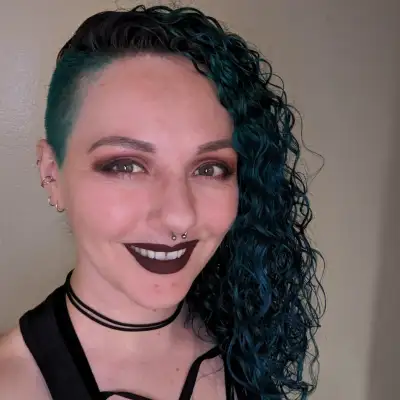
Jenna “Jennissary”: [00:01:16] Thank you so much. Yeah. Thank you so much for having me on. This is, I’m so delighted to be talking about this field that I’m very, very passionate about. So as you said, my name’s Jenna. I work for Descriptive Video Works, which is a Keywords Studio. And I’m a producer specializing mostly in video games. But I do still get to write, which is very, very fortunate. So, for the benefit of those, which I believe is most people listening on audio-only or who are themselves visually impaired, I am a white woman in her mid 30s of average build, and I have curly green hair and a side shave and a nose piercing. So that should give you an idea of what we’re working with here.
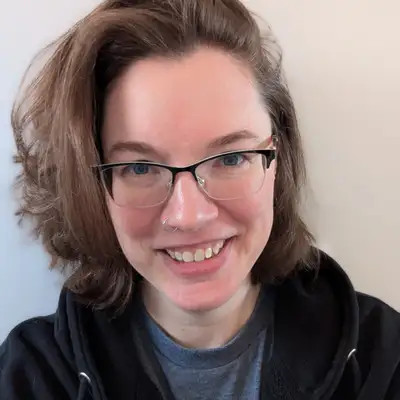
Kate Mueller: [00:01:57] I can attest to the curly green hair 100%. And since I’ve never done this, I am a white woman in my mid 40s. I would say also probably average build with glasses and a nose ring and today very unruly brown hair. So I am blaming the humidity on that one.
Jenna “Jennissary”: [00:02:13] I was going to say exactly that. Blame the humidity.
Kate Mueller: [00:02:15] Yeah, we’re getting rain for the first time in, like, eight weeks. So it’s berserk over here folks, it’s Medusa hair.
Jenna “Jennissary”: [00:02:22] It feels great, but it has consequences.
Kate Mueller: [00:02:24] Yeah. So Jenna, for folks who have never even heard the phrase audio description, maybe let’s start there. What is audio description?
Jenna “Jennissary”: [00:02:32] Yes. If you’re listening to this and you have immediately thought of closed captions, then you’re not alone. That is a lot of what we deal with is people mixing us up with subtitling and captioning, when in reality we’re kind of the inverse of that. We’re like the equivalent of subtitling or captioning for blind and visually impaired viewers. So what that is, is you take a movie or a TV show or a live broadcast or a video game or something that has a mix of both audio and video. And we script a narrator who speaks between the existing dialog to describe the visuals on screen.
Kate Mueller: [00:03:09] And if you’re not familiar with audio description or you’ve never heard it before, Jenna’s been kind enough to share some samples with us. So let’s listen to some.
Speaker 1: [00:03:18] No, but you gotta see this.
Speaker 2: [00:03:19] Peter follows Miles into a stairwell. Together they vault and swing up the landings using webs shot from their wrists. They burst onto the rooftop.
Speaker 3: [00:03:29] In a dark void, sand drops through the neck of an hourglass into a heaped pile. The last grain slows in the air, then bursts into cosmic light. The light pulses.
Jenna “Jennissary”: [00:03:43] Most of the time this is pre-scripted. So we receive a movie. We write a full script for the audio description, we narrate it, we mix it, and we send it back to the distribution platform. But it can also take the form of live audio description that can either be pre-scripted or improvised for live events like awards shows, parades, presidential inaugurations. We’ve done it all. And in video games, it normally takes the form of describing things that have fixed timing. So things like cinematics, finishers, anything that is, like, we know exactly how long it’s going to take in the game. The video games portion of it is my bread and butter, but I get to work in a lot of different fields as well.
Kate Mueller: [00:04:26] Oh, this is so exciting. It’s so varied and I love just the accessibility focus on it. I think most of us do think about closed captioning, but in the land of technical documentation, this is sort of the equivalent to doing alt text for images, except you’re doing it with moving cinematic visual experiences rather than a static image along the way.
Jenna “Jennissary”: [00:04:48] 100%. Yeah. And if anyone is interested in checking out audio description, it’s on almost any major streaming platform as a different audio track. I think Amazon is different because they have a specific accessibility thing where they let you change the audio description and then change the language separately, but in most other streaming platforms, if you go into spoken languages, there will be, for example, English and then English audio described as a separate spoken language option. And if you ever want to turn your favorite movie or TV show into a podcast and listen to it in the background, when you are otherwise occupied, like you’re doing the dishes or you’re driving or you’re walking somewhere and you can’t keep your eyes glued to the screen the entire time, then audio description is a good way to absorb that.
Kate Mueller: [00:05:35] Oh, I love that idea of turning something you would normally be watching into a podcast while you do other things. Obviously, I’m a little pro podcast. I have a little bit of bias there. So. Fascinating. So, Jenna, what is your villain origin story on getting into doing audio description? Because this does not, like tech writing, this feels like one of those things where it’s like, it’s not a thing that, you know, you’re five years old and you’re dreaming of going into audio description. It feels like maybe it’s a thing you fall into in some way. So tell me about that.
Jenna “Jennissary”: [00:06:05] Sort of. Yeah, it’s interesting how many different ways people come to audio description. Usually it’s the route of like they’ve already been in media and broadcast and they got interested in it through that. But prior to this, I was actually working in regulatory affairs for a pharmaceutical manufacturer, which is a different form of tech writing, which is much drier. I’ll tell you that much. So we were writing…
Kate Mueller: [00:06:31] Regulatory affairs? Yes, I would say that’s a bit drier than video games. Yes.
Jenna “Jennissary”: [00:06:34] Yeah, definitely. Yeah. So we were the department that interfaced with health authorities like the FDA or Health Canada or something like that on behalf of the company to gain approval for things like changes that we wanted to make or new drug products. Not nearly as exciting. It was great work. And it’s a very lucrative field. However, I had always been interested in disability advocacy, more from a social point because I joined a club when I was in college because the people who were tabling for it were really chill. And I was like, I just kind of want to hang out with y’all a little more. And then I started getting really passionate about accessibility via that. But in the back of my mind, my subconscious motivation is like, these people are just kind of cool and I like them and want to spend more time with them, and I want their lives to be easier. Over Covid, I, like many other people, got into live streaming just to kind of stay in touch with other people that I already knew about, and made a lot more virtual online friends. I made buddies with a few completely blind people who were live streaming video games to keep in touch with other people in exactly the same way. And I just started hopping on Discord calls with them and assisting them with the gaps in otherwise inaccessible games, either by virtually lending my controller inputs to them where I would take care of like the aim and they would do everything else, or I would start live audio describing some stuff to them. The origin of me getting into audio description specifically was a buddy of mine, SightlessKombat, who now works for the Royal National Institute of Blind People, posted on the God of War Subreddit. I am a chronically online Redditor and I love God of War so much. It’s my favorite franchise. And he was posting about this very emotional scene that happens about midway through the game where he’s like, I know there’s a lot going on visually.
Jenna “Jennissary”: [00:08:28] I know it’s very heavy and significant because of the music, but I don’t really, like, there’s no dialog. I don’t really know what’s happening, and I’m not getting the full emotional weight of this. There’s this thing called audio description. Would anyone in this community who’s familiar with the game want to take a crack at it? And I kind of read that and I was like huh, that’s interesting. I should start playing some games with this guy. This sounds pretty cool. But what really got me into it was someone else had already left a comment with their attempt at describing the scene, and my dumb ass read through that and I was like, “You know what? I could do better.” And that was the very villainous origin of me being like, nah, let me take a crack at this because I feel like it deserves…I want to do it justice because it was such an emotionally heavy scene and then SightlessKombat and I started talking. We got on, we went down an entire rabbit hole. We ended up just making a fan project audio describing the entirety of the game that’s up on his YouTube channel now where I wrote and voiced it and he did all the QC and mixing and everything. And from there I started educating myself a bit more in the rules of audio description.
Jenna “Jennissary”: [00:09:41] I started getting more training. I got in touch with Descriptive Video Works thanks to a referral from another friend of mine, and then started doing contract work. And then they offered me a full time position a few months later, because it turns out they really needed someone who knew a little bit about video games.
Kate Mueller: [00:09:59] Oh my gosh, this is such a fantastic evolutionary story, I love it.
Jenna “Jennissary”: [00:10:04] Very different.
Kate Mueller: [00:10:06] Yes, 100%. I love that it’s very non-linear. Also the goal here was not let me get a job, it was, let me help solve this, you know. Oh, somebody is asking for help. Let me help a little bit. And also that like, oh my goodness, I could do a better job than this other person.
Jenna “Jennissary”: [00:10:25] Yeah. I mean, like, compared to my normal day job, I started kind of just doing that on the side because it was actually fun compared to what I was doing previously. Not a rap against regulatory affairs or anything. It was, you know, it was work. It was a steady paycheck. It was great benefits. I didn’t hate it or anything. It just wasn’t really super fun.
Kate Mueller: [00:10:49] Well, and I think there’s also if you’ve done something for a while, it may not be as great as it was in the beginning. And so you’re a little bit more open to something that does feel challenging, that feels like you’re going to get stretched a little bit. And that also does I mean, in this case, that also just sounds like it was a lot of fun.
Jenna “Jennissary”: [00:11:08] It worked out really well. Yes. Yeah. I’d been doing it for eight years and I was looking for something. I was looking for a change.
Kate Mueller: [00:11:15] Yeah. I mean, you know, I think that’s not uncommon for a lot of us. We hit a point where we kind of plateau at a company or in a position and hit a point where it’s just something new, anything new would be fantastic. But then something new that’s actually, you know, kind of like a partial pivot into something else can be way more exciting at that point. You already gave us a rundown of what your current role looks like, but can we dig into that just a little bit more in terms of, you know, so you’re a producer, among other things. What does the day to day look like for you?
Jenna “Jennissary”: [00:11:54] It’s always different, which in some ways is nice. In some ways it’s a little chaotic, but my role is as producer. So most of what I do is wrangling other people. But Descriptive Video Works is a bit of a smaller studio and the majority of our workforce takes the form of contractors because we don’t have any control over the volume that our largest clients will give us from month to month. So there will often be surges and lulls in what we’re expected to get through and how quickly we’re expected to get through it. So most audio description writers and narrators are contractors who will flow between all of the different audio description companies depending on who’s got the volume that month. A lot of them are part time, some of them do this full time. The contract work is all they do. But my part in it means that I get to organize those contractors, do a lot of quoting and project management, but I also get to handle client review. So once we have a draft script, sometimes (not always) the client will want to go through it and review it a little more thoroughly. And I can help guide them as to which of their ideas adhere to audio description standards and practices, and which of them we might not be able to take on board. I also get to write as well for a lot of the projects that I manage, especially if they are things for which I’m very knowledgeable about. Finding writers who have the knowledge bases that are specific to the thing that they’re writing for is a great way to get higher quality audio description, because it means they don’t have to waste a bunch of time on research.
Jenna “Jennissary”: [00:13:36] So if I’m, you know, writing for Heated Rivalry, I’m probably going to pick someone who knows a little bit about hockey because I would have to go and look up the name of whatever moves or equipment they’re doing on the rink. What are they putting on? What’s this helmet called? Whereas someone who knows a little bit about hockey would know what everything is called, so they can just use the names of those things in their script. I also get to live audio describe a lot of stuff as well. Since I am sort of the gaming industry expert in the world of audio description, it means I am usually the one who is roped into doing major gaming industry events, so just last week I was at Gamescom in Germany helping do live audio described tours of the Xbox booth area. Xbox has us back frequently for a lot of their major announcements. Before that I was helping them with their June showcase, so I was the one who wrote and voiced that. I’ve been doing the Game Awards and Summer Game Fest for a few years running, so any time there is some sort of major industry event, most of the time it’s going to be me who ends up doing it.
Kate Mueller: [00:14:45] Wow. All right. It’s a big…
Jenna “Jennissary”: [00:14:46] Lot of different hats.
Kate Mueller: [00:14:49] Yeah. I was going to say you’re, as a producer, you’re, that’s project management. That’s, you know, getting people to do things, that’s seeing that stuff stays on task. But you’ve also got that element of potentially doing back and forth with clients to review scripts. So there’s a lot of client facing work in there plus live description events. So I mean, do you find that that helps you kind of keep your hand in doing descriptions because you’re doing live events and rolling with the punches there?
Jenna “Jennissary”: [00:15:21] I do still try to at least write a few things for any of the projects that I’m managing, because I don’t want to lose touch with the skill of writing. Live description is sort of a, it’s a little bit of a different skill set because it is a lot more cognitively taxing for a very short-term thing. But writing is something where if you are given the luxury of time to pick exactly what you want to say, how you want to phrase it, what words you should and shouldn’t be using, what’s falling out of favor. That sort of helps you develop and internalize those skills that then help the live description rather than the live description helping the writing aspect of it. For me, it’s important to not lose the very valuable skill of being a good AD writer. Well, decent. Let’s not toot my own horn too much.
Kate Mueller: [00:16:24] You mentioned in these back and forths with clients that you’re reviewing scripts, and there are certain standards or requirements that you’re trying to assess whether what they’re asking for can be met. And I don’t know much about this field at all. So is that like, are there regulatory bodies that govern this that are specific to nations, for example, or what are those kinds of requirements that scriptwriters, for example, would have to be working within?
Jenna “Jennissary”: [00:16:54] Yeah. It might shock you to know how few rules there are in this field at all. So there are some in other similar accessibility or writing fields that are like this, there are, like you said, regulatory bodies or ways to take exams and gain certifications in that particular aspect of writing or translation or interpretation. For audio description, there’s not really any of that. There is no centralized body in any nation that determines what audio description rules should be, what the standards and practices are. The standards and practices come from two sources. One are the studios and producers, the largest producers of audio descriptions, so studios like the one I work for, and then the desires and the internal practices and guidelines of major clients. So audio description is commissioned and owned by the distribution platform, so that might be a theatrical release platform, most often that is a streaming service platform nowadays. But if you are, you know, Netflix, Disney, Hulu, Amazon, or something like that, most of them will have their own internal set of guidelines for standards for audio description. Netflix, I think, is the only one that has posted those publicly. So you can go and look up what they’re looking for when they review our audio description, but if what they want changes or if they decide to do things differently, then that is obviously going to have a ripple effect where studios kind of end up adapting their own internal practices to match that, and other media companies might take note and adapt their practices accordingly.
Jenna “Jennissary”: [00:18:35] So one example was about five years ago, there was a sort of shift where prior to that, audio description wasn’t really commonly describing someone’s visual ethnicity or their racial appearance. But there was sort of a shift and a discussion with the blind viewership community asking them, okay, is this important? Should we include this? Should we update our standards? And the conclusion was yes, that they needed to. That is visual information that is available to sighted people that prior to that audio description had been kind of depriving the blind audience of. So if you’re making a TV show and you’re going to the effort to cast authentically or to cast in a diverse manner, and then you’re not telling a minority audience member about it, it effectively doesn’t exist to them.
Jenna “Jennissary”: [00:19:24] And if you are, you know, blind and a minority ethnicity, it is doubly important to know that someone, a character you identify with, is going to, like, something is going to have something more there that you can further connect with. So that was a shift in the standards about five years ago that most major media companies then took up and adopted. And then most major audio description studios updated their internal practices, which is what we default to, if we have a client who doesn’t have their own internal policies or guidelines. So there have been a few attempts at getting a centralized certification together, but I don’t know where that’s going to go or if that’s going to find success, because there is an inherent level of subjectivity that comes with writing audio descriptions in what you choose to say and how you choose to say it, and how much time you dedicate to it. The guidelines themselves will be things that seem kind of obvious, like, don’t describe over dialog. Of course, there’s exceptions to every rule. Sometimes you have to prioritize the visual descriptions over background dialog or something. Don’t insert your own opinion into the audio description. Don’t pass judgment on it. Say only what you see. Don’t describe sounds. That’s something a lot of new writers fall into a lot. Let the sound effects or the dialog speak for themselves if it’s self-evident.
Jenna “Jennissary”: [00:20:52] A lot of guidelines like that. But once you actually get into it, there is a little bit of subjectivity and creativity that you can put into it because you might have a few synonyms available to describe a waterfall or a person’s facial expression or a dress or something. And all of those would be technically correct and objective. But then you can pick the one that has the right vibe for what you’re looking for. Maybe something sounds a bit more rich or a bit more scummy or something makes it sound a bit more ruddy and rundown, and that can help immerse the viewers a little bit more in what the vibe of this visual is. So because of that level of subjectivity, I don’t know if it’s going to eventually be possible to sort of standardize audio description in the same way that other tech writing is, but maybe, maybe that’ll change someday. Right now, it’s all sort of very vague and just based on what the largest players in this game are doing at the moment.
Kate Mueller: [00:21:56] Are there ever cases where some of those big players actually have conflicting guidance? So, you know, you have to be aware of who you’re doing it for because there are subtle variations or in some cases, very glaring variations between them, or are they more or less generally aligned?
Jenna “Jennissary”: [00:22:15] Yeah, there are like, oh, one thing I forgot to mention: our internal guidelines at DVW are determined by an advisory committee of blind film critics who we meet with frequently to discuss any developments or changes or questions that might have come up in unique scenarios. I don’t know how other studios do it, but it’s important to try to maintain that connection with the audience who actually needs and consumes this. There have been some very weird guidelines that I have received from clients. Because of NDAs, I can’t say exactly who it was or exactly what the guideline was, but I’ll make up an equivalent hypothetical. Let’s say there’s a new client who gives us and there’s a horror movie, but they’ve given us the guideline that we can never mention blood. So we have to figure out because of whatever their concerns might be, perhaps there are ratings concerns in other regions. Maybe they need to translate this to other languages, and the writers in those languages will refuse to talk about blood or whatever the case, the equivalent of blood in this case. So we have to find out. We kind of have to do cartwheels to imply the blood without directly mentioning the color or texture or the existence of the blood, which in my opinion, is very, it’s not great in terms of accessibility.
Jenna “Jennissary”: [00:23:49] It’s almost like a form of censorship for an audience that does not need any more censorship. So there have been weirdly conflicting things like that that have come up. And then that sort of raises the question internally of like, is it morally right for us to be adhering to this guideline? Should we refuse this job? If we do that, does that mean another, less scrupulous or lower quality studio is then going to take it up? Is that going to make it even worse? How do we serve the community the best? So obviously, if we have guidelines like that, that come up, we will do our best to open a conversation with the client to try to pick their brain on why this is happening and what the best practices might be. But that doesn’t always go anywhere. So sometimes we just have to adhere to these strange guidelines of not describing blood.
Kate Mueller: [00:24:43] In a horror film where there’s gonna be a fair amount of blood.
Jenna “Jennissary”: [00:24:46] I mean, that’s not something that’s actually happened. But you can imagine other equivalents of objectionable content. Yeah, yeah.
Kate Mueller: [00:24:53] Or what some cultures consider objectionable content. So you get into that sort of cultural relativity soup, I guess I’m going to call it, where there’s not necessarily a right answer, but there’s a lot of shades of what should we be doing here? Is it right that we should be doing this? Yeah, I could see that. That’s an interesting layer of editorializing. It feels like because you want to accurately describe what’s there. But then you have this additional external parameter that’s like, oh, nope, you can’t quite exactly describe exactly what’s here.
Jenna “Jennissary”: [00:25:30] And then sometimes people online will be like, you know, we’ll try to keep in touch with people who are reacting to or commenting on the audio description. And sometimes we’ll see comments online that are like, why aren’t they describing the blood or something? And we just can’t talk about it because that’s an internal guideline that’s under NDA.
Kate Mueller: [00:25:50] Oh. Oh, yeah. Fun times there.
Jenna “Jennissary”: [00:25:53] It’s very fun. Yeah. Yeah.
Kate Mueller: [00:25:56] Lots to navigate. It sounds like in certain cases.
Jenna “Jennissary”: [00:25:59] Yes.
Kate Mueller: [00:26:00] Weird follow up here. So I’ve been describing this as tech writing. You have described it a bit as tech writing. Is that just because I’ve invited you on the podcast and framed it as tech writing, or do you actually consider it to be tech writing outside of the context of this?
Jenna “Jennissary”: [00:26:14] It’s sort of a little bit of tech writing and creative writing. It’s both of them just smooshed together because there are so many technical aspects to this. So I mean, in short, yes, I would consider this to be tech writing. However, it’s not strictly only tech writing. There are a lot of parameters that we need to adhere to. Mostly, most of them have to do with timing. So our scripting can only happen, our narrator can only be speaking when characters aren’t speaking. We will also try to script around hero sound effects, or if there’s a major theme that comes through, or some climactic music or licensed music, we’ll want to let some of the lyrics come through. So we have specialized software where we can script lines with in codes and out codes that show the timing of when we want the narrator to start and stop speaking. We also have parameters for how fast they can speak, because we can’t just artificially speed up how fast they’re talking in order to accommodate all of the things that we want to say within a given gap, because that is bad cognitively. We don’t want someone to have to process a ton of additional information and break the flow and break the pacing of the scene. So we can only have things, we can only say a certain amount of things within a certain window. And we have a lot of different tools to estimate how long a narrator is going to take to say certain things. But you become an expert at finding synonyms that have fewer syllables. You become an expert at being concise and saying the same thing with fewer words and fewer syllables.
Jenna “Jennissary”: [00:27:59] And it’s a very weird skill to have, but it’s a very necessary one. So we have to avoid sentence fragments. We have to avoid tongue twisters for our narrators. We usually try to avoid alliteration. Sometimes it’s fun. If it’s a comedy, I’ll throw in a little more alliteration because it’s kind of fun. But we have to avoid things that are not going to sound great in the narrator’s accent. If they have a pronunciation of a word that sounds exactly like a character name, that’s happened before, then we avoid that word a little bit more, or we have some space with the character name. We have to use characters’ names any time the action changes hands, sort of like in prose writing, we have to write all of the subtitles because subtitles are purely visual. If it’s characters switching to dialog in a different language, then we have to transcribe the subtitles for our narrator to read out loud, talking over top of the subtitled dialog. If there are three or more characters in a scene who are all talking and they’re all subtitled, then what we’ll do is we’ll actually cast additional narrators, and each of them will be assigned a speaker in that scene so that we don’t have to say “Bryan,” “Yen,” and have our narrator hop in between every line of dialog to specify who’s speaking, because that’s additional cognitive load. So there’s a lot of technical aspects of it. But yeah, it is a mish mash of both creativity and technical writing.
Kate Mueller: [00:29:37] Yeah. I mean, I think there’s in some ways a whole lot of overlap in the sense that like, one of my big themes to harp on here is that a big piece of being a good technical writer is that you are able to take something that’s really complicated and explain it in a simplified way that somebody can understand and taking the richness of visual qualities and distilling that down to a number of words that you only have so much time to get through is very much taking a complicated thing and trying to simplify it down into the most essential pieces, but also the pieces that are going to–in this case, it’s not just that objective, accurate description, but that bit of like, am I striking the right tone? Am I hitting the right sort of emotional volume in this, which is, you know, generally a level of nuance we don’t have to tackle a whole lot in tech writing, but they’re definitely, I think all of us, to some extent have that “I am making stylistic choices within these technical requirements. How do I make the right stylistic choices to present here for this?” I would say the other oh, the other theme tie down I think I’ll go for here is that one of the things a lot of us focus a great deal on is “what is my end user’s experience going to be like, engaging with what I’m writing?” And that is so central to the work that you’re doing. You’re thinking about, okay, how do I effectively convey this? But can I convey it in a way that’s both going to be accurate and striking the correct tone, but also fitting within these constructs, but also not loading people up with so much that they’re having to try to process cognitively extra stuff. Because at a certain point, you’re overwhelming your listener in this case. And so it undermines the effectiveness of what you’re doing. So I think it’s a different set of constraints, but it’s still very much thinking about that end user and what that experience is going to be like, and making sure that what you’re creating is going to work for them, is actually going to enhance the experience, right?
Jenna “Jennissary”: [00:31:48] Another big part of it is mentally, you kind of have to recognize and overcome biases that come with being a sighted person. So I tend to not notice or not hear certain things in the same way as an audience member who’s going to be consuming something on audio description alone. One thing I’ll notice when I’m reviewing with clients often is one goal of audio description is to be contemporaneous so that what you’re describing is on the screen while you’re describing it. But obviously there’s often rapid flashes of action. There’s dialog going on over critical visuals. So you have to sometimes either describe something slightly before or after it’s actually happening. And that happens a lot. But when people are reviewing audio description and they’ve never seen it before, that tends to trip them up because they’ll say like, “Oh, I noticed you’re describing this thing, but that doesn’t actually happen until five seconds later.” And that is a bit of a sighted bias because in reality, the audio-only experience of that is going to be better quality than if we were to try to shove that into the place where it technically strictly happens visually, but it doesn’t flow as nicely in an auditory manner. There are also like, there’s some really clever things that you can do. Given the choice, it is slightly better to describe an action just before it happens, so that the person has time to listen to it and process it, and then it happens. So this happens a lot during fight scenes. So if someone’s throwing a big haymaker after a wind up, you describe them running and lining up a Superman punch. And then right when that description finishes, you get “hyuh-kah!” That’s kind of the ideal way to phrase it.
Jenna “Jennissary”: [00:33:41] And if you can describe something that’s sort of evocative right before some licensed song lyrics come through, that’s also really cool. And even if that might not strictly line up with visuals, which can kind of trip you up as a sighted person, if the auditory flow of it is better that way, then it’s better to do it like that. There’s also certain biases, like I might script something in a certain way, and then upon review, if I’m just reading through the script by itself, find that the phrasing is confusing because it’s like, oh, I thought he, it makes it sound like he’s just handing the screwdriver to himself because you’ve like did it in X, Y, Z order. So then you kind of have to take another pass at it and rephrase it because if you’re not seeing on the screen what’s happening and also reading through or listening to the script to have that confirmed and reinforced then via the script alone, the phrasing is confusing or is missing crucial information. So these are like a lot of weird mental things that you end up having to do that are pretty fun as a mental exercise.
Kate Mueller: [00:34:49] It sounds really interesting in that way because you obviously have to start with the visual to create the description you’re working on, but then it’s as if you have to divorce it from the visual to think about what the audio track is going to sound like and what the experience of that’s going to be. Yeah, it does sound like a shift in how you have to think about that a little bit. And actually, in the interest of not cognitively overloading folks, maybe this is a good time for us to take a break and to come back as well.
Kate Mueller: [00:35:21] This episode is sponsored by KnowledgeOwl, your team’s next knowledge base solution. You don’t have to be a technical wizard to use KnowledgeOwl. Our intuitive, robust features empower teammates of all feathers to spend more time on content and less time on administration. Learn more and sign up for a free 30-day trial at knowledgeowl.com.
Kate Mueller: [00:35:43] Alright. And we are back. So, Jenna, let me go back to something you said earlier, which is when you called yourself a good AD writer, but then you immediately corrected it to be like, oh, no, I’m a decent AD writer. Decent or good, whatever we want to use here. But what are the skills and the qualities of a good AD writer?
Jenna “Jennissary”: [00:36:01] Yeah, it’s a great question because, I mean, aside from the baseline level of being able to adhere to all of the guidelines that we throw at people, some of which are evolving or changing constantly, it is the ability to output quickly and accurately is massively valuable. So usually the rule of thumb we give is for an hour of uninterrupted work, people can usually write audio descriptions for ten minutes of some sort of consecutive media form. So if it is a 60-minute movie, I know those don’t really exist, but if it’s a 60-minute movie, optimally it will take at least six hours of uninterrupted work. So movies typically take a few days of full time just for one person to write the audio description script. So you can imagine if we are having a larger volume of, you know, dozens or hundreds of movies or TV shows or multiple seasons of TV shows, we usually have to dedicate multiple writers to different seasons of that same TV show, which means they have to coordinate with each other to say things like, “What are you calling this thing? Does anyone know what this character’s pronouns are? What did you describe this character as when they first appeared?” So the ability to work collaboratively is another good one, usually in a way that is just like not work collaboratively in the sense that you all have to sit down and go to a meeting about this horrible group project that you’re doing, more so that you can just add to existing documentation quickly and be able to recognize gaps in what other people might be writing about and be able to anticipate some questions that other people might have to confront or might have already confronted.
Jenna “Jennissary”: [00:37:58] And then also just the ability to use accurate but evocative language and be able to use some cool phrasing for stuff or pick the right synonym for the word, or not use tons of padding with unnecessary prepositions or filler phrases, just to be able to have the most optimal concise experience for the viewer. That’s sort of the echelon between a good AD writer and an excellent AD writer is if I’m reading through a script and I go, “Ooh, that’s good.” That’s sort of the difference between the two of those things. But most of what makes someone a good and consistent AD writer is just being able to output consistently, adhere to a schedule, and adhere to guidelines.
Kate Mueller: [00:38:51] Okay. It seems like it’s a great exercise if you are someone who tends toward the slightly more verbose to have to do it more succinctly, in the same way that writing poetry is very different from writing short stories. You have to use fewer words to try to convey the same thing. And I definitely know some writers who would benefit from needing to be less verbose, potentially myself included in that. This is not me throwing shade at people.
Jenna “Jennissary”: [00:39:19] The weird thing is that sometimes you have to do the opposite because my favorite thing is long, panning, establishing shots that go on for like ten or twenty seconds because then you kind of have to do the opposite. You have to be a lot more flowery. You’ve got to throw in a couple of metaphors. The clouds are fluffy, like cotton candy, or maybe, maybe something feels ominous. So you have to use words like looming overhead or drawing close or something. So like, there are times where you have to do the exact opposite of what usually makes a good AD writer and kind of go on and chew on the scenery a little bit. But those are very rare, unfortunately.
Kate Mueller: [00:40:04] But probably like a good little break to have to exercise the other muscles, right?
Jenna “Jennissary”: [00:40:09] It’s really nice when that happens. Yeah.
Kate Mueller: [00:40:12] You’re not completely atrophying that skill set at the same time. I like it. And what is? Okay, so if I’m sitting down to work on a script for this, what does the sort of tool stack or tech stack that I’m using for this look like? You mentioned that there are some tools that will help you gauge how much time you have available between things to be able to slot narration in, but is there specialized software or is there specialized equipment? What does that look like?
Jenna “Jennissary”: [00:40:39] Yeah, so there is specialized software. There are a few different ones out there that are specifically made for writing audio description. A lot of the software that we end up using–there are also larger streaming service clients that have their own proprietary software because they want more security. So you end up having to write in their software in a web browser. So you’re just kind of at the mercy of whatever features they do or do not choose to include. But for the standalone pieces of software that we tend to use, some of them will be made for audio description. Most of them are made for other purposes. So the one that we use for recording is actually made for ADR. So for dialog replacement. So that one has, like, it can store lines in the form of in code and out code timing. And it can store multiple different takes of a narrator speaking to it, and it can marry it up with a piece of source media. We have also used software that is made for captioning and subtitling, because it usually is able to export the scripts in a way that the ADR software can ingest or in a way that the reviewer can actually look at it and review it without needing to use that software themselves. So we end up using things from all over the place, really. But the important thing is that it allows you to put a line in there and have a timecode and timecode in and timecode out associated with that line, and to be able to play and preview that alongside the media that you’re writing for. But we use a lot of different tools to get there.
Kate Mueller: [00:42:21] That sounds like a bit of a hodgepodge of things. You know, this thing works really well for this. This thing works really well for this. We’re working with, you know, this client and here’s the thing that they want us to use for this thing. Yeah.
Jenna “Jennissary”: [00:42:33] And then security guidelines are always another extra layer on top of that because most of us are fully remote. We usually just work from home, but some clients will. I mean, we undergo extensive security audits both internally and externally all the time. But a lot of clients will want an extra layer of security where they want the writer to physically go into one of their studio locations to write the script. And then we have to work with them to figure out which of the softwares can be installed on their machines and all sorts of different things. So yeah, some of the security guidelines that I as a writer or producer have had to adhere to when going on to client sites are pretty interesting. You would think it was, you know, Area 51 or something.
Kate Mueller: [00:43:20] I immediately was like, what is with the, is the primary concern there that something would get leaked before it went live?
Jenna “Jennissary”: [00:43:26] Yes.
Kate Mueller: [00:43:27] Okay all right. So they’re trying to protect IP to some extent and get the launch that they want for the...
Jenna “Jennissary”: [00:43:33] Yeah. Because we’re given an early copy of the video for whatever it is. By way of example, this wasn’t anything to do with us, but a couple years ago, Netflix unfortunately had a very big leak with a lot of their major animes because I believe it was a third party translation service that leaked a bunch of them online. So yeah, they have to give us very locked down video proxies or watermarked proxies or deep fried video, horrible quality proxies, or they have to make us work only within their proprietary software, which disables any screen recordings or we physically go into their studio to write for it. Because you have to imagine, I mean, we are handling very high profile material. Some of our biggest clients are Amazon, Netflix, and Disney, and none of them are a single studio provider of audio description. So they will sometimes give stuff to us, sometimes to other studios depending on vibes or volume or contracts with them. But we do often end up handling major movies or TV shows prior to their theatrical releases or to their premieres. And obviously me working in video games, those are very popular and have the public eye very much. So, yeah, security guidelines are a massive part of what we have to adhere to.
Kate Mueller: [00:45:00] And actually, since you’ve brought up video games again, I’m going to ask a question that I really wanted to ask during your villain origin story, which is I have not thought about this previously to any large extent, but how do blind people play video games? You mentioned, you know, doing controller work for somebody, but like, what does that actually look like?
Jenna “Jennissary”: [00:45:24] Yeah, I mean, it depends. So it’s always going to be different depending on the game. But if the game itself has adequate accessibility features to be fully playable for blind players, of which there are quite a few nowadays, then the game is going to convey all relevant information to them on audio and haptics alone. So what that means is all of the text in the menus or on the UI or the HUD are going to be converted to text to speech. So if a character picks up a note in an environment instead of it just being text on screen, it is text to speech that you can control the playback for. If there is like, let’s say The Last of Us is a third-person shooter. It has different sound effects for when you are successfully aiming at something. It has target snapping and auto aim. If you have a lock on someone and whether it’s head, torso, or limb, when you shoot at them, there’s a different sound effect for if you hit or if you kill them, or if you just injure them.
Jenna “Jennissary”: [00:46:26] There are different sound effects for if it’s the last clip in a magazine, different sound effects for if you’ve picked up something and now it’s craftable. Most of these are UI sound effects that are very helpfully evident of what they are. And then there are some text to speech alerts that are elective for when the player chooses it. So you can, at any time in The Last of Us, you can swipe on the touchpad and it’ll tell you if you’re in grass, if you’re in heavy cover, if you’re obscured, if you’re crouched or standing, and how much health you have left, how much ammo is left in your magazine, what you have equipped. So that is elective and you can do that at any time. All sorts of things. There are some gameplay formats where it is, even without any dedicated accessibility features, it is sort of inherently accessible. So rhythm games tend to be very inherently accessible. Two-dimensional fighting games have been very popular for a couple decades among the blind community, because it is flat, two-dimensional on the screen, and you can use the stereo panning in your headphones to locate who is where and how far apart they are.
Jenna “Jennissary”: [00:47:30] Nowadays, a lot of fighting games have put a little more effort into it to beef up those accessibility features, so they have a bunch of different sound effects for whether you or your opponent is blocking, crouching, attacking, whether your hits are connecting, whether it’s a high, mid, or low hit, all things that are relevant to the gameplay have then been converted to have equivalent sound effects to reflect those visuals, so that you have all of the same information that a sighted player does. That’s not to say that all games are fully accessible. There is a wiki for blind accessible games that shows which ones have a lot of accessibility features, which ones are only accessible if you’re low vision but not completely blind. And nowadays, the modding community has started writing player-created mods, which are an additional piece of software that you can download and that runs alongside the game to do extra stuff to make it more accessible. So some of them will add those sound effects or text to speech functions to make the game more accessible. We still have a long way to go before it becomes common and the norm, but it is becoming more and more common as time goes on. Blind people have been playing games for as long as video games have been around. It’s just getting a lot easier nowadays.
Kate Mueller: [00:48:48] Because people are actually thinking game designers are actually thinking about, how do we make sure that we’re including this because it’s an audience, a paying audience, just like anybody else.
Jenna “Jennissary”: [00:48:59] Blind people have money. Let them spend it on you.
Kate Mueller: [00:49:02] Don’t we all? Leisure and entertainment is fantastic. And you also mentioned earlier that a lot of the folks who are doing audio description are basically contractors, because there is that ebb and flow in work. How do people get started doing this kind of work, particularly because it is that sort of contractor relationship? So it doesn’t feel like you have, you know, in the tech writing world, in some traditional capacities, there’s the concept of like, okay, you might intern, you might become a junior technical writer. There’s sort of a path of mentorship for you to get there. And an entirely contractor-fed workforce, which much tech writing also is now, you don’t quite have that same sort of natural development over the course of time. So what does it look like for somebody trying to start out or break in?
Jenna “Jennissary”: [00:49:52] Yeah. So there’s no strict tiers in that sense of entry-level writers. I can’t speak to what other studios do, but what we do at DVW, when someone is looking to be onboarded as a new writer. Okay, let me go through the normal process first, and then I’ll talk about some specialized programs that we have. So if someone is wanting to be onboarded as one of our contractors, we will give them a survey on what, if any, experience they have and then any specialized knowledge bases that they might have. So let’s say, for example, they are a horror fanatic or they have prior military service. So they have a lot of knowledge that could be useful for war documentaries or movies like that. If someone has specialized knowledge that is particularly relevant to something that we need, then we’re obviously going to want to fast track them a little bit. For us, we also give them a writing test where we basically hand them a 10 to 15 minute chunk of a movie and tell them to write a script for it. And what the script is changes pretty often, but we will then review their script against our internal quality guidelines and see if there are any major glaring issues with whatever they have given us. If they don’t really seem to have any idea about what audio description is, then we will send them to some training and education resources, which are typically unfortunately self-funded. So there are a lot of classes that aren’t really affiliated with any particular studio that you can go take part in. There are some free training materials out there so you can self-educate yourself a little bit. If someone has taken one of those training courses, then we’ll be more likely to consider them.
Jenna “Jennissary”: [00:51:40] But if their script is really, really good, or if they need a little more consideration, we might give them another shorter video to test them on some gaps that we might see in their knowledge. And if their script is workable and they might have a couple of quality concerns, but nothing that’s not fixable, then we’ll add them to our roster of writers who will be given work, depending on what they’re trained on, what their knowledge base is, what their availability is and if they have any objections to anything, like they don’t want to write for extremely violent or gory things, they don’t want to write for sexual content, that sort of thing. So it just all depends. We also have a couple of specialized training programs that we have worked with, sometimes with Netflix, but sometimes just by ourselves, where we have noticed over the years that audio description writers tend to be white, middle aged, and men. So we have funded a few specialized training programs to try to change that a little bit and try to bring more voices into the fray who are going to be a little more knowledgeable on things that we are not as white people or as middle-aged people.
Jenna “Jennissary”: [00:52:53] DVW has worked with the Queer Women of Color Film Festival to fund a, I forget how long it was, but a training program to train a small group of queer women of color on the norms and practices of audio description. And by the end of that, each of them was given a test script to write. And that allowed us to sort of handpick the ones who had a real knack for audio description to add to our roster immediately from there, and the ones who needed a little more practice were then free to take that training along with the ones who we added to our roster. All of them were free to take that training to other audio description services, but the idea was to just get more writers out there in the world, even if we don’t necessarily have exclusivity over their writing skills and writing prowess, but we wanted them to come work for us a little more, obviously, but that wasn’t a requirement of it. So we funded a few training programs like this where we’re trying to beef up the diversity of audio description writers a little bit because we could really need that.
Kate Mueller: [00:53:59] Yes. I mean, I think to some extent that’s true of tech writing generally, not just audio description, but yes, those are fantastic programs. I mean, a really nice kind of entry level. Let’s get you in, get you to understand, see if you have skills here to do the thing in a field that is not one that necessarily looks like you belong in it, but you do belong in it. We just haven’t had the talent to put people here.
Jenna “Jennissary”: [00:54:26] Yeah. It does take some training. It does take some practice. There are also people who will just have side projects where they write audio description for things for free, just because it’s fun or they want to keep their skills sharp, or they want to describe something that they want to describe instead of what a client sends them. So there is also a website called YouDescribe where blind viewers will make requests on YouTube videos that they want audio descriptions of, and anyone can go in there and add audio description of it. It’s not always good, but it is a great way to practice, see if you’ve got a knack for it. And it’s pretty fun because some of the things that people request are, I often see cooking and baking videos because sometimes they’ll just be showing the ingredients and measurements on the screen instead of talking through it. And workout and meditation videos are pretty frequent requests on there, which is pretty cool. It’s a lot of fun. So if you want to take a look at just some fan-created or user-created ones, that’s a great way to do it.
Kate Mueller: [00:55:29] Oh, YouDescribe, huh? And I guess this is a great time to ask. Are there any resources that you think are helpful that we should share with our audience?
Jenna “Jennissary”: [00:55:39] Yeah. I mean, I’ve mentioned the Netflix audio description guidelines are a great place to start. The American Council of the Blind also has a very well maintained database of all movies and TV shows that have audio description and what platforms they have that audio description on. So it’s called The American Council of the Blind Audio Description Project. And very not coincidentally, but fittingly, I serve on their new (it’s a year old at this point) their new video gaming subcommittee, which also has a list of all video games that are audio described. Within the next few months, we’re also going to be publishing the first ever set of quality guidelines for video game audio description. The ACB also has published a list of quality guidelines for movies and film, or for film and TV shows over the years. They have some guidelines on where to find audio description and how to access it. And yeah, just that full list of things that are audio described is a great place to start if you are looking to recommend something to either yourself or someone in your life who might benefit from audio description.
Kate Mueller: [00:56:46] And maybe shifting gears just a tiny bit. What is a great piece of advice that you’ve been given, Jenna? It does not have to have anything to do with writing or audio description or video games or anything.
Jenna “Jennissary”: [00:56:57] That was a really tough one. Sorry. I’m realizing this was actually in the email, but I mentally, I thought we would kind of breeze past it or we would, or I would magically come up with something.
Kate Mueller: [00:57:08] You know, I hold people to this because sometimes the advice I get is incredible. Sometimes it’s very funny. I forget which guest it was, I’m sorry, whomever you were, but one of them shared a piece of advice from, I think one of the British royal family members, which was whenever you have an opportunity to use a restroom, use it.
Jenna “Jennissary”: [00:57:31] Oh, yeah, that’s a good one!
Kate Mueller: [00:57:32] Yeah. So I, you know, I’ve gotten some that are sort of motivational, inspirational and then some that are much more practical. So the range is–there is no limit.
Jenna “Jennissary”: [00:57:44] Yeah, I guess I’ll throw in this is just sort of my life advice for people: if there’s anything about your day to day or your work environment or just things that you’re doing, repetitive tasks especially, if there’s something that bugs you, change it, do something about it. There are so many little annoyances that we have to deal with every day that we do actually have control over. I’ll give one example. I’m looking down at my mechanical keyboard right now, which last year I replaced all of the keycaps with ones that are taller and narrower at the top because I like to keep my fingernails long, and I like having a space to tuck those long fingernails in behind the keycaps so that I can still have an ergonomic typing method with my nice little leatherette wrist rest and my RGBs and everything, and it became so much more comfortable when I didn’t have to feel guilty about this nice thing that I like doing for myself and contorting my fingers in really weird ways. So I realized I didn’t want to give up the long fingernails, and the keyboard was the only thing that was annoying me about them, so I changed it. Change it.
Kate Mueller: [00:58:54] Yeah. It’s funny. Talking about cognitive overload. Sometimes all those little annoyances can really add up to something that feels very stressful. And if you can remove a couple of them, just how much smoother and easier is life at that point? And I guess lastly, Jenna, now that I’ve held you to giving a piece of advice. Easy question here: If people listen to this and they’re like, oh my goodness, I really want to, you know, I want to follow Jenna or I want to reach out to her or whatever. What is the best way for them to do that?
Jenna “Jennissary”: [00:59:29] I would love if everyone could go follow me everywhere. So I go by Jennissary on almost all social media platforms. You can find me unfortunately on Twitter but also on Bluesky, Twitch, YouTube, LinkedIn, or you can email me at jenna@dvworks.com if you have any additional questions about this lovely world of audio description or if you just want to see me play through some of the games that I’ve worked on while talking about accessibility or posting updates about accessibility or getting involved in gaming accessibility, it’s always good vibes. It’s a lot of fun.
Kate Mueller: [01:00:09] It sounds fantastic. I hope some folks do connect with you. I’m already connected with you now and I’m so thankful for that. So yes, thank you so much for your time and sharing your experience and your knowledge.
Jenna “Jennissary”: [01:00:20] Thank you for having me on. This was great.
Kate Mueller: [01:00:29] The Not-Boring Tech Writer is co-produced by our podcast Head of Operations, Chad Timblin, and me. Post-production is handled by the lovely humans at Astronomic Audio with editing by Dillon, transcription by Madi, and general post-production support by Been and Alex. Our theme song is by Brightside Studio. Our artwork is by Bill Netherlands. You can order The Not-Boring Tech Writer t-shirts, stickers, mugs, and other merch from the Merch tab on thenotboringtechwriter.com. You can check out KnowledgeOwl’s products at knowledgeowl.com. And if you want to work with me on docs, knowledge management coaching, or revamping an existing knowledge base, go to knowledgewithsass.com. Until next time, I’m Kate Mueller, and you are the not-boring tech writer.
Creators and Guests